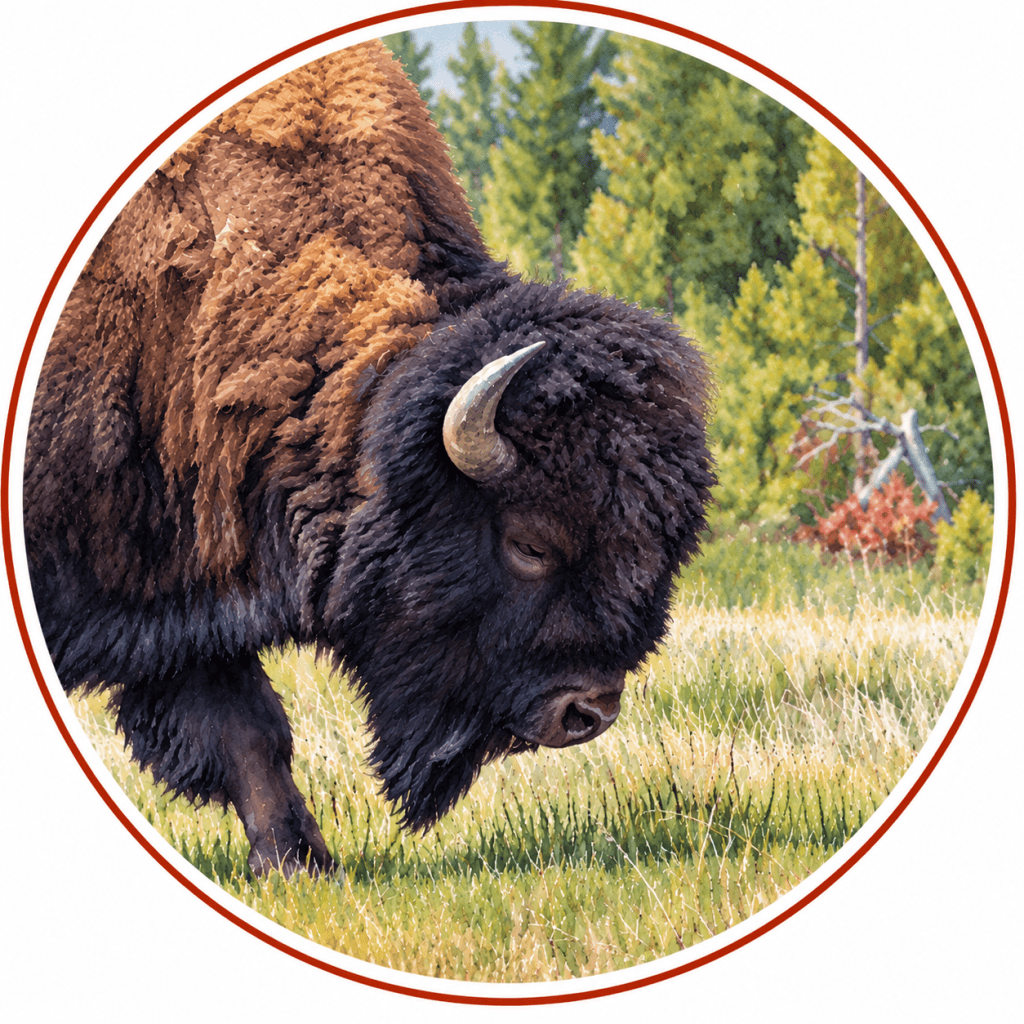
Scientific Name: Bison bison
Family: Bovidae — Cattle, Antelopes, Sheep and Goats
The largest land mammal in North America, the American Bison is an iconic symbol of the continent’s grasslands. Once numbering in the tens of millions, its populations were nearly exterminated during the 19th century. Conservation efforts have helped restore this magnificent grazing giant to protected landscapes.

Identification
North America’s largest terrestrial mammal, with massive forequarters, a pronounced shoulder hump, large head, short curved horns, and shaggy dark-brown hair on the head, neck, and forelegs. The hindquarters are noticeably smaller. Bulls are substantially larger than cows. Two living subspecies are generally recognized: Plains Bison and Wood Bison.
Similar Species
There is little realistic field-identification confusion within its native range. Domestic cattle lack the bison’s extreme shoulder hump, massive head, and characteristic shaggy forequarters. European Bison is a separate species and generally has a less massive forequarter profile, longer legs, and somewhat different body proportions. The common name “buffalo” is widely used in North America, but the animal is a true bison.
Natural History
Bison are primarily grazers whose movements, grazing, trampling, dung, and wallowing reshape grassland structure and create habitat for many other organisms. Cows and young commonly form herds, while mature bulls may be more solitary outside the summer rut. Their ecological influence makes bison a keystone component of functioning prairie systems.
Habitat & Distribution
Historically ranged from northern Mexico across the Great Plains and into parts of the boreal and mountain west. Today wild and conservation herds occupy only a small fraction of that range. Plains Bison are associated mainly with grasslands and parklands; Wood Bison occupy more northern boreal meadow, wetland, and open-forest landscapes.
Conservation
IUCN Red List: Near Threatened (NT) • Population trend: Stable
The species survived a catastrophic nineteenth-century collapse from tens of millions of animals to only a remnant. Numbers have recovered dramatically, but most bison now live in commercial or intensively managed herds rather than large, free-ranging populations. Conservation concerns include limited habitat, isolated conservation herds, genetic diversity, cattle-gene introgression in some herds, disease, and barriers to restoring landscape-scale movements.
My Encounters
[Place / Region]
[Describe a firsthand encounter with this species in this place. Focus on what you observed, photographed, noticed, or learned rather than simply recording that the species was present. Add additional geographic H3 sections only when meaningful encounters from other places warrant them.]
Through My Lens
[REPLACE EXAMPLE IMAGES AND CAPTIONS. Select photographs that add something beyond identification—behavior, habitat, season, light, movement, or another aspect of the encounter. Use the image orientation and layout that best serve the photographs rather than forcing images into a standard format. For landscape-oriented photographs, begin with one row of two images; add additional photographs only when they genuinely contribute.]

Ceres WTP, California — July 30, 2025
1/250 sec · f/10 · ISO 160

Ceres WTP, California — July 30, 2025
1/2500 sec · f/10 · ISO 6400
Explore More
[Related Place]
[Invite the reader to explore a place meaningfully connected with this species or encounter. Delete this pathway if there is no useful place connection.]
[Related Natural World – i.e., Shorebirds]
[Invite the reader to continue exploring a meaningful related group, habitat, organism, or natural-history topic. Choose the connection that best encourages further discovery rather than simply adding a related link.]
From Reflections of the Natural World
[When this species has a meaningful presence in a Reflections story, invite the reader to continue into that story. Include only stories in which the species contributes meaningfully to the encounter—not those where it merely appears on a list. Delete this pathway if no meaningful story connection exists.]

