← Back to Crows, Jays and Magpies
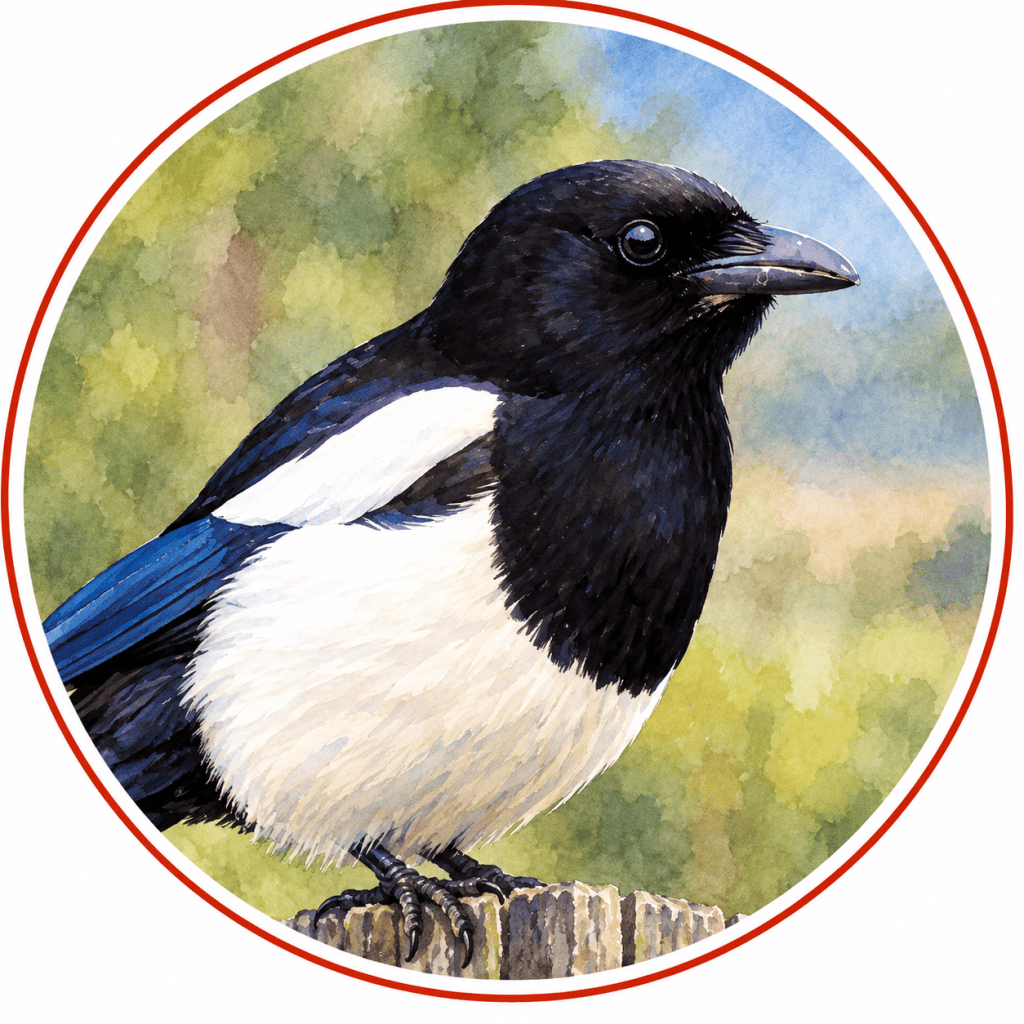
Scientific Name: Pica hudsonia
Family: Corvidae — Crows, Jays and Magpies
A striking member of the crow family, the Black-billed Magpie inhabits western North America’s open woodlands, grasslands, and agricultural landscapes. Recognized by its bold black-and-white plumage and exceptionally long tail, this intelligent, inquisitive bird is a resourceful omnivore with complex social behaviors.

Identification
The Black-billed Magpie is one of the most distinctive birds of western North America’s open country. A large member of the crow family, it combines a glossy black head, breast, and back with brilliant white shoulders and underparts. Its exceptionally long, wedge-shaped tail and iridescent blue-green wing and tail feathers are especially striking in sunlight.
In flight, bold white patches flash across the wings, creating a dramatic contrast with the otherwise dark plumage. Its strong black bill, confident movements, and frequent harsh calls make it an unmistakable presence in grasslands, ranchlands, and agricultural landscapes.
Similar Species
Yellow-billed Magpie (Pica nuttalli): Nearly identical in body shape and black-and-white plumage, but distinguished by its bright yellow bill and yellow skin surrounding the eyes. The Yellow-billed Magpie is restricted to California, whereas the Black-billed Magpie occupies a much broader western North American range.
Eurasian Magpie (Pica pica): Very similar in appearance, including its black bill, long tail, and iridescent plumage. Geographic location is usually the most useful distinction, as the Eurasian Magpie inhabits Europe and much of Asia rather than North America. Their vocalizations also differ.
Natural History
Black-billed Magpies are highly intelligent, social, and opportunistic birds. Their varied diet includes insects, small vertebrates, seeds, fruits, carrion, and occasionally eggs and nestlings. They frequently forage on the ground and are well known for gathering around animal carcasses.
Pairs construct elaborate domed nests from sticks, often incorporating a protective roof and one or more entrances. These substantial structures may take several weeks to complete. Magpies maintain complex social relationships, communicate through varied vocalizations, and may gather in communal groups outside the breeding season.
Habitat & Distribution
The Black-billed Magpie inhabits western North America, from southern Alaska and western Canada south through the Rocky Mountain and Great Plains regions of the United States.
It favors open landscapes with scattered trees or shrubs, including grasslands, agricultural fields, pastures, riparian corridors, and rural settlements. In Saskatchewan, it is a familiar year-round resident of prairie and parkland environments, particularly where open feeding areas occur near suitable nesting vegetation.
Conservation
IUCN Red List: Least Concern (NT)
The Black-billed Magpie remains widespread and is not considered globally threatened. Nevertheless, regional populations can be affected by habitat alteration, persecution, pesticide exposure, and diseases such as West Nile virus.
Maintaining a mosaic of open foraging areas, trees, and shrublands helps support this adaptable species. Its continued presence in agricultural landscapes also illustrates the complicated relationship between wildlife and human land use.
My Encounters
[Place / Region]
[Describe a firsthand encounter with this species in this place. Focus on what you observed, photographed, noticed, or learned rather than simply recording that the species was present. Add additional geographic H3 sections only when meaningful encounters from other places warrant them.]
Through My Lens
[REPLACE EXAMPLE IMAGES AND CAPTIONS. Select photographs that add something beyond identification—behavior, habitat, season, light, movement, or another aspect of the encounter. Use the image orientation and layout that best serve the photographs rather than forcing images into a standard format. For landscape-oriented photographs, begin with one row of two images; add additional photographs only when they genuinely contribute.]

Ceres WTP, California — July 30, 2025
1/250 sec · f/10 · ISO 160

Ceres WTP, California — July 30, 2025
1/2500 sec · f/10 · ISO 6400
Explore More
[Related Place]
[Invite the reader to explore a place meaningfully connected with this species or encounter. Delete this pathway if there is no useful place connection.]
[Related Natural World – i.e., Shorebirds]
[Invite the reader to continue exploring a meaningful related group, habitat, organism, or natural-history topic. Choose the connection that best encourages further discovery rather than simply adding a related link.]
From Reflections of the Natural World
[When this species has a meaningful presence in a Reflections story, invite the reader to continue into that story. Include only stories in which the species contributes meaningfully to the encounter—not those where it merely appears on a list. Delete this pathway if no meaningful story connection exists.]

