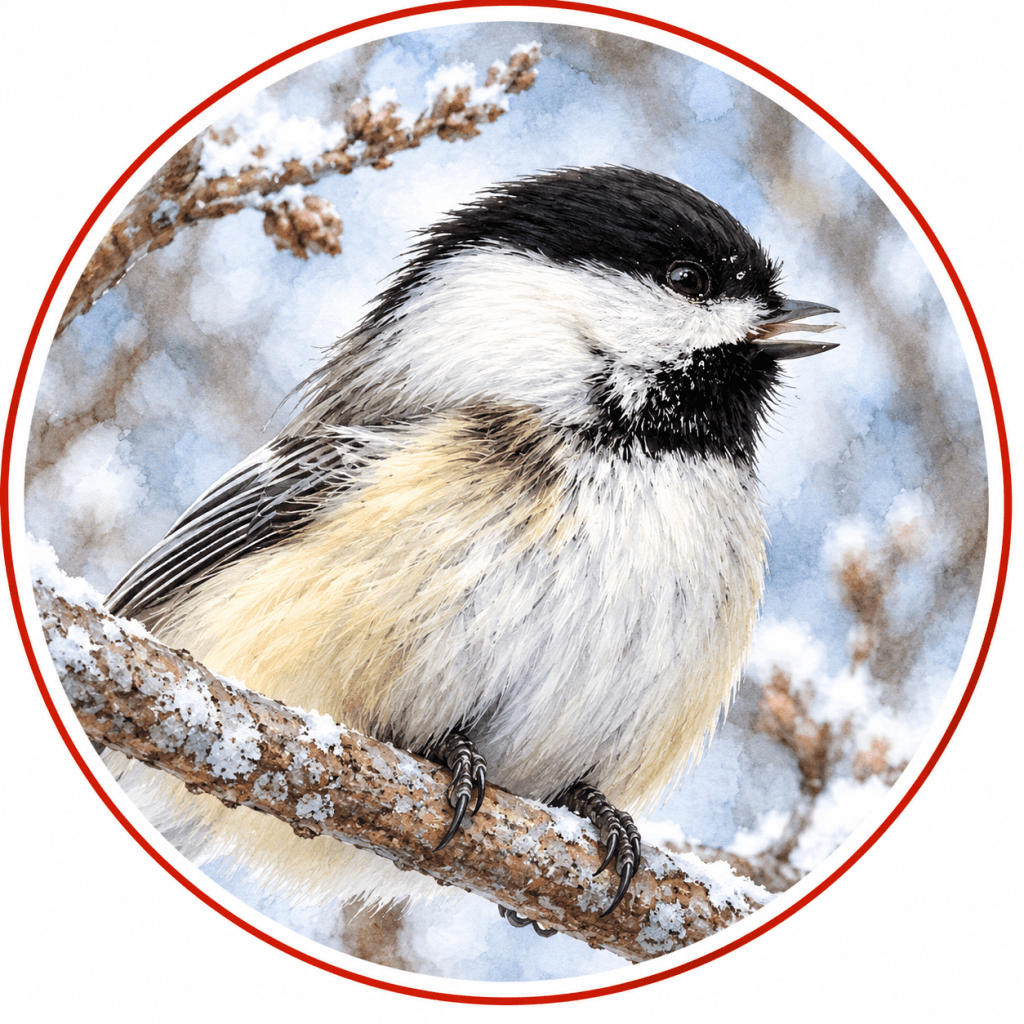
Scientific Name: Poecile atricapillus
Family: Paridae — Chickadees and Tits
A familiar resident of North America’s woodlands, the Black-capped Chickadee is celebrated for its cheerful calls and remarkable adaptability to harsh winters. This energetic little songbird survives freezing temperatures by storing food, remembering countless hiding places, and sheltering in protected cavities during cold nights.

Identification
The Black-capped Chickadee is a small, energetic songbird recognized by its bold black cap and throat, bright white cheeks, soft gray back, and pale underparts with buff-colored flanks. Its rounded head, short bill, and compact body give it a distinctive appearance.
Frequently encountered in small, active flocks, chickadees move acrobatically through branches while searching for food. Their familiar chick-a-dee-dee-dee calls and clear, whistled songs are characteristic sounds of northern woodlands. Despite their delicate appearance, these remarkably hardy birds survive some of North America’s coldest winters.
Similar Species
Carolina Chickadee (Poecile carolinensis): Extremely similar in appearance, particularly where the two species’ ranges meet. Carolina Chickadees generally show less extensive white edging on the folded wing feathers and slightly less buff coloration along the flanks. Vocalizations and geographic range are often more reliable identification clues, although hybridization complicates identification in contact zones.
Mountain Chickadee (Poecile gambeli): Similar in size and behavior but readily distinguished by its prominent white eyebrow above the black facial markings. Mountain Chickadees primarily inhabit western mountain forests, particularly coniferous habitats.
Natural History
Black-capped Chickadees are remarkably well adapted to cold climates. During autumn, they cache thousands of seeds and other food items in bark crevices, branches, and hidden locations, later retrieving many of these stores through an impressive spatial memory.
Their diet consists primarily of insects, spiders, seeds, and berries, varying with season. Chickadees excavate nesting cavities in decaying wood or use existing cavities and nest boxes.
Outside the breeding season, they form small social flocks with established dominance hierarchies. Their vocalizations communicate information about food, flock movements, and potential predators. On extremely cold nights, they can lower their body temperature to conserve energy.
Habitat & Distribution
The Black-capped Chickadee occupies much of northern North America, extending across Canada and the northern United States.
It inhabits deciduous and mixed forests, woodland edges, riparian corridors, parks, and residential neighborhoods. Mature trees and standing dead wood provide important nesting and foraging opportunities.
In Saskatchewan, the species is a familiar year-round resident of wooded habitats, including the Aspen Parklands, boreal forests, and Saskatoon’s urban woodlands.
Conservation
IUCN Red List: Least Concern (LC)
The Black-capped Chickadee is widespread and remains relatively common across much of its range. Its adaptability to parks, gardens, and suburban habitats contributes to its resilience.
Nevertheless, habitat fragmentation, loss of suitable nesting trees, climate change, and changes in insect availability may affect local populations. Maintaining native trees, natural cavities, and diverse woodland vegetation helps provide essential habitat.
My Encounters
[Place / Region]
[Describe a firsthand encounter with this species in this place. Focus on what you observed, photographed, noticed, or learned rather than simply recording that the species was present. Add additional geographic H3 sections only when meaningful encounters from other places warrant them.]
Through My Lens
[REPLACE EXAMPLE IMAGES AND CAPTIONS. Select photographs that add something beyond identification—behavior, habitat, season, light, movement, or another aspect of the encounter. Use the image orientation and layout that best serve the photographs rather than forcing images into a standard format. For landscape-oriented photographs, begin with one row of two images; add additional photographs only when they genuinely contribute.]

Ceres WTP, California — July 30, 2025
1/250 sec · f/10 · ISO 160

Ceres WTP, California — July 30, 2025
1/2500 sec · f/10 · ISO 6400
Explore More
[Related Place]
[Invite the reader to explore a place meaningfully connected with this species or encounter. Delete this pathway if there is no useful place connection.]
[Related Natural World – i.e., Shorebirds]
[Invite the reader to continue exploring a meaningful related group, habitat, organism, or natural-history topic. Choose the connection that best encourages further discovery rather than simply adding a related link.]
From Reflections of the Natural World
[When this species has a meaningful presence in a Reflections story, invite the reader to continue into that story. Include only stories in which the species contributes meaningfully to the encounter—not those where it merely appears on a list. Delete this pathway if no meaningful story connection exists.]

