← Back to Crows, Jays and Magpies
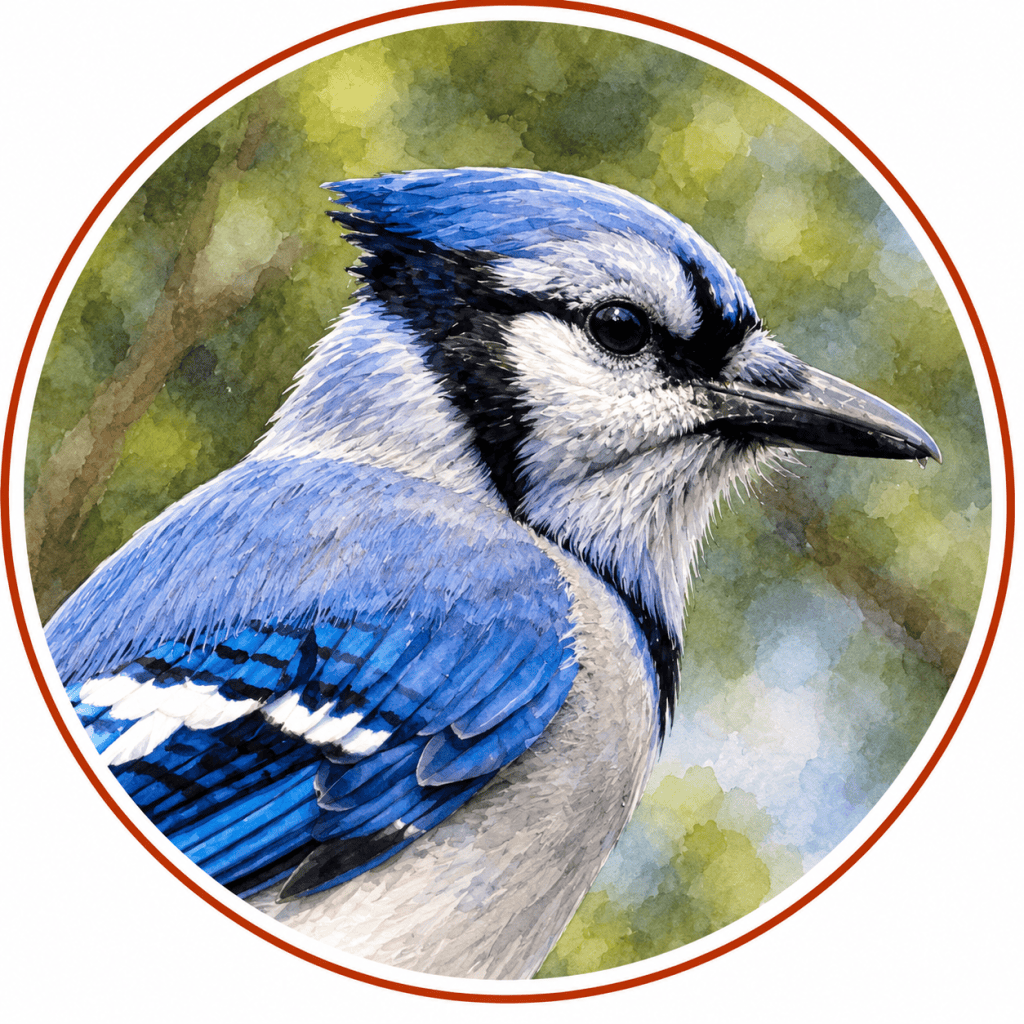
Scientific Name: Cyanocitta cristata
Family: Corvidae — Crows, Jays and Magpies
A colorful and intelligent resident of eastern North America’s woodlands and neighborhoods, the Blue Jay is recognized by its brilliant blue plumage, prominent crest, and unmistakable calls. An accomplished mimic and resourceful forager, it plays an important ecological role by collecting and dispersing acorns.

Identification
The Blue Jay is a boldly patterned woodland bird distinguished by its brilliant blue upperparts, prominent crest, white face and underparts, and striking black markings around the head and throat. Its wings and tail display intricate black-and-white barring, creating one of North America’s most recognizable bird silhouettes.
Despite its vivid appearance, the Blue Jay’s blue coloration results from microscopic feather structures that scatter light rather than from blue pigment. Intelligent, vocal, and often conspicuous, this species is equally at home in mature forests and wooded neighborhoods
Similar Species
Steller’s Jay (Cyanocitta stelleri): Another large, crested jay, but with a much darker head and upper body, generally lacking the Blue Jay’s white face and bold white wing markings. Steller’s Jays are primarily associated with western North American forests.
California Scrub-Jay (Aphelocoma californica): Shares the Blue Jay’s blue coloration but lacks a crest and has a different facial pattern. Its blue wings and tail contrast with a grayish back and pale underparts. It occupies western oak woodlands, scrublands, and suburban habitats.
Natural History
Blue Jays are intelligent and adaptable omnivores that consume acorns, nuts, seeds, insects, fruits, and occasionally small animals. Their habit of collecting and burying acorns makes them important agents of oak seed dispersal, helping establish new trees beyond existing woodland boundaries.
They possess a varied vocal repertoire and can imitate the calls of hawks and other birds. Family relationships are strong, and pairs cooperate in raising their young.
Some Blue Jays migrate seasonally, while others remain year-round. Their migration patterns are unusually variable, with individuals sometimes migrating in one year but remaining resident in another.
Habitat & Distribution
Blue Jays inhabit eastern and central North America, from southern Canada through much of the eastern United States, with their distribution extending into portions of the Great Plains.
They favor deciduous and mixed forests, particularly those containing oaks, but readily occupy wooded suburbs, parks, and agricultural landscapes with mature trees.
In Saskatchewan, Blue Jays occur in suitable wooded habitats, including urban neighborhoods, river corridors, and parkland forests. They are particularly noticeable around feeders and areas with established tree cover.
Conservation
IUCN Red List: Least Concern (LC)
The Blue Jay remains widespread and adaptable, although population trends vary regionally. Its ability to use human-modified landscapes has helped maintain its presence across much of eastern North America.
Potential threats include habitat loss, window collisions, disease, and changes in food resources. Preserving mature native trees, particularly oaks, supports both Blue Jays and the broader ecological communities that depend on woodland habitats.
My Encounters
[Place / Region]
[Describe a firsthand encounter with this species in this place. Focus on what you observed, photographed, noticed, or learned rather than simply recording that the species was present. Add additional geographic H3 sections only when meaningful encounters from other places warrant them.]
Through My Lens
[REPLACE EXAMPLE IMAGES AND CAPTIONS. Select photographs that add something beyond identification—behavior, habitat, season, light, movement, or another aspect of the encounter. Use the image orientation and layout that best serve the photographs rather than forcing images into a standard format. For landscape-oriented photographs, begin with one row of two images; add additional photographs only when they genuinely contribute.]

Ceres WTP, California — July 30, 2025
1/250 sec · f/10 · ISO 160

Ceres WTP, California — July 30, 2025
1/2500 sec · f/10 · ISO 6400
Explore More
[Related Place]
[Invite the reader to explore a place meaningfully connected with this species or encounter. Delete this pathway if there is no useful place connection.]
[Related Natural World – i.e., Shorebirds]
[Invite the reader to continue exploring a meaningful related group, habitat, organism, or natural-history topic. Choose the connection that best encourages further discovery rather than simply adding a related link.]
From Reflections of the Natural World
[When this species has a meaningful presence in a Reflections story, invite the reader to continue into that story. Include only stories in which the species contributes meaningfully to the encounter—not those where it merely appears on a list. Delete this pathway if no meaningful story connection exists.]

