← Back to Crows, Jays and Magpies
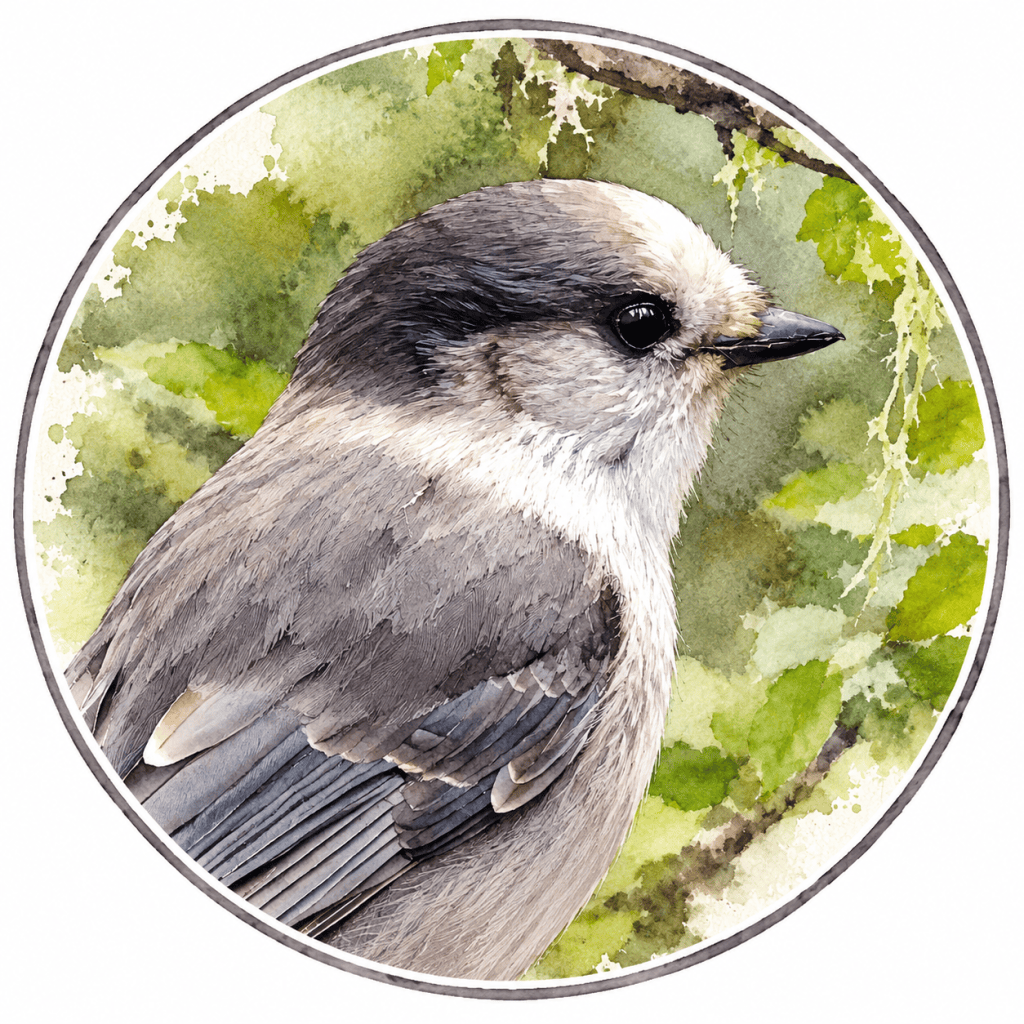
Scientific Name: Perisoreus canadensis
Family: Corvidae — Crows, Jays and Magpies
The Canada Jay is a resourceful and inquisitive bird of northern forests, recognized by its soft gray plumage, pale face, and dark cap. Remarkably adapted to cold climates, it stores food throughout the year and remains active even during the harshest winter conditions.

Identification
The Canada Jay is a medium-sized member of the crow family, characterized by its rounded head, relatively short bill, long tail, and soft, fluffy plumage. Adults have a pale gray to whitish face and forehead, contrasting with a dark gray cap extending across the crown and nape. The back, wings, and tail are predominantly gray, while the underparts are lighter, often appearing pale gray or whitish.
Unlike many other jays, Canada Jays lack a prominent crest and display relatively subdued coloration. Their thick, insulating plumage gives them a rounded appearance, particularly during cold weather. The bill, legs, and feet are black, and the dark eyes stand out against the pale facial feathers.
Juveniles differ noticeably from adults, appearing almost uniformly dark sooty gray, with limited contrast between the head and body. They gradually acquire the more distinctive adult plumage during their first year.
In flight, Canada Jays display broad, rounded wings and a relatively long tail. Their movements through forested habitats are often deliberate and buoyant, with short flights between branches and occasional glides. They are frequently approachable, sometimes investigating people or campsites in search of food.
Similar Species
Blue Jay (Cyanocitta cristata): A larger, more brightly colored jay with a prominent crest, blue upperparts, white underparts, and bold black markings. Although both species occur in portions of Canada and the northern United States, their distinctive plumage makes separation straightforward.
Steller’s Jay (Cyanocitta stelleri): A larger, darker jay with a conspicuous pointed crest, dark head and upper body, and blue wings and tail. Steller’s Jays inhabit western coniferous forests and may overlap geographically with Canada Jays in mountainous regions.
Clark’s Nutcracker (Nucifraga columbiana): Another gray-and-black member of the crow family associated with western mountain forests. Clark’s Nutcrackers are larger, with long, pointed bills, contrasting black wings, and prominent white patches in the wings and tail. Their overall shape and flight pattern differ substantially from those of Canada Jays.
Natural History
Canada Jays are exceptionally well adapted to life in cold northern forests, where they remain active throughout the year rather than migrating to warmer climates. Their survival depends heavily on an unusual and highly developed food-caching strategy.
Throughout the warmer months, Canada Jays collect insects, spiders, berries, fungi, carrion, and other available food. They coat many food items with sticky saliva and conceal them in bark crevices, among lichens, beneath loose vegetation, and in other sheltered locations. These scattered caches provide essential nourishment during winter, when fresh food becomes scarce.
Their remarkable spatial memory allows them to relocate stored food across extensive forest territories. The success of this strategy depends partly on cool environmental conditions that help preserve cached food for extended periods.
Unlike most North American songbirds, Canada Jays begin nesting in late winter, often while snow still covers the ground and temperatures remain well below freezing. Breeding pairs construct well-insulated nests using twigs, bark strips, lichens, feathers, and other materials that help protect eggs and nestlings from severe weather.
Canada Jays maintain strong territorial and family relationships. Breeding pairs generally remain together throughout the year, and one juvenile may stay with its parents through the following winter while its siblings disperse.
Their inquisitive behavior has earned them several traditional names, including Gray Jay, Whiskey Jack, and Camp Robber. The name Whiskey Jack derives from Indigenous cultural traditions associated with Wisakedjak, a trickster figure in some Algonquian-speaking cultures.
Despite their often-confiding behavior around people, Canada Jays remain highly specialized forest birds whose survival is closely connected to the ecological conditions of northern and high-elevation woodlands.
Habitat & Distribution
The Canada Jay inhabits boreal and subalpine forests across northern North America, ranging from Alaska through much of Canada and southward into mountainous regions of the western United States and portions of the northeastern United States.
It is strongly associated with coniferous forests, particularly those containing spruce, fir, pine, and other evergreen trees. These habitats provide suitable nesting locations, year-round shelter, and abundant surfaces for storing food.
In Canada, the species is characteristic of extensive boreal forest landscapes, including the forested regions of Saskatchewan. It can be encountered in mature spruce and mixed conifer forests, woodland edges, and forest openings, where individuals frequently move between trees while searching for food.
Farther south, Canada Jays occur primarily in high-elevation forests, including portions of the Rocky Mountains, Cascade Range, and Sierra Nevada. In California, they are resident in suitable montane coniferous forests, particularly in the northern mountains and Sierra Nevada.
Canada Jays are generally nonmigratory, maintaining territories throughout the year. Although local movements may occur, especially among younger birds, most adults remain closely associated with established forest habitats.
Conservation
IUCN Red List: Least Concern (LC)
The Canada Jay remains widespread across northern North America and is not currently considered globally threatened. Its populations are difficult to monitor across the vast boreal forest, but long-term surveys suggest that numbers have been relatively stable overall. Nevertheless, the species’ close dependence on cold forest environments makes it potentially vulnerable to changing climatic conditions.
My Encounters
[Place / Region]
[Describe a firsthand encounter with this species in this place. Focus on what you observed, photographed, noticed, or learned rather than simply recording that the species was present. Add additional geographic H3 sections only when meaningful encounters from other places warrant them.]
Through My Lens
[REPLACE EXAMPLE IMAGES AND CAPTIONS. Select photographs that add something beyond identification—behavior, habitat, season, light, movement, or another aspect of the encounter. Use the image orientation and layout that best serve the photographs rather than forcing images into a standard format. For landscape-oriented photographs, begin with one row of two images; add additional photographs only when they genuinely contribute.]

Ceres WTP, California — July 30, 2025
1/250 sec · f/10 · ISO 160

Ceres WTP, California — July 30, 2025
1/2500 sec · f/10 · ISO 6400
Explore More
[Related Place]
[Invite the reader to explore a place meaningfully connected with this species or encounter. Delete this pathway if there is no useful place connection.]
[Related Natural World – i.e., Shorebirds]
[Invite the reader to continue exploring a meaningful related group, habitat, organism, or natural-history topic. Choose the connection that best encourages further discovery rather than simply adding a related link.]
From Reflections of the Natural World
[When this species has a meaningful presence in a Reflections story, invite the reader to continue into that story. Include only stories in which the species contributes meaningfully to the encounter—not those where it merely appears on a list. Delete this pathway if no meaningful story connection exists.]

