← Back to Crows, Jays and Magpies
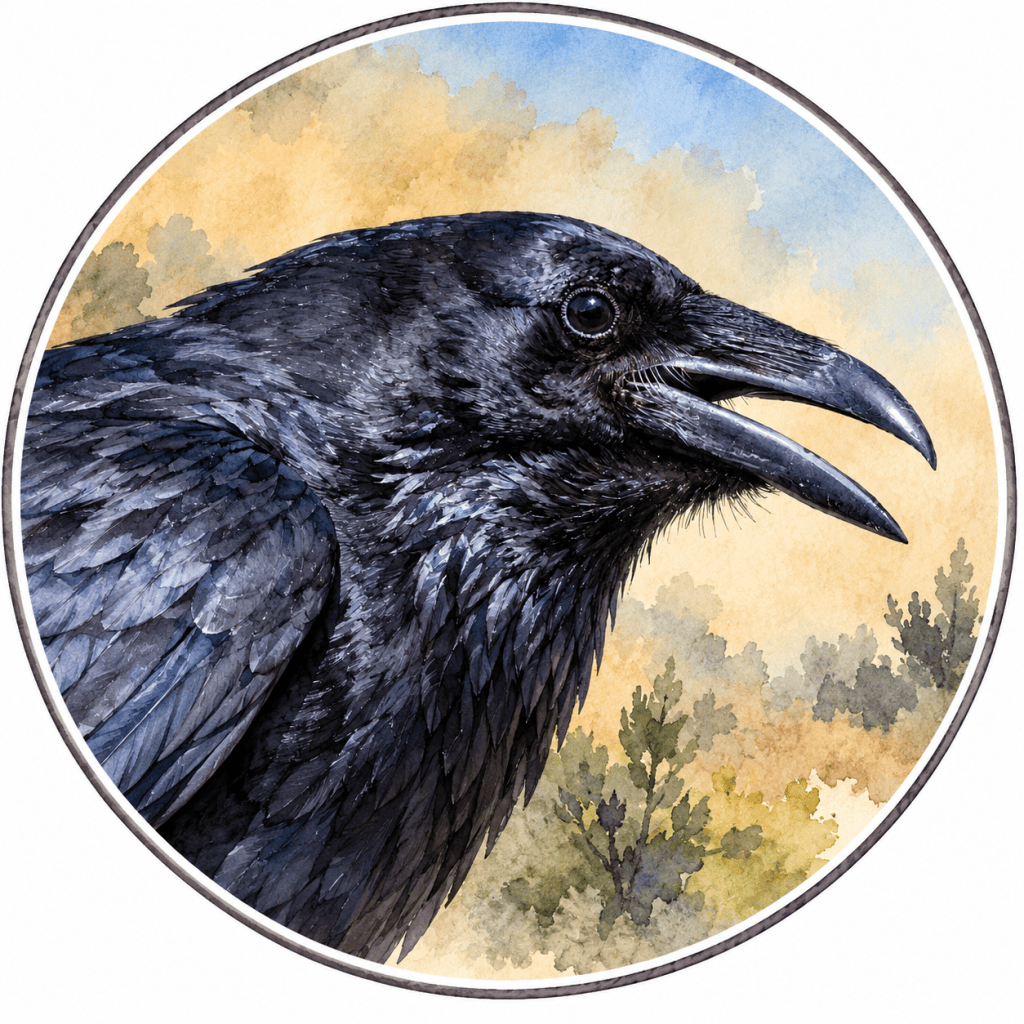
Scientific Name: Corvus corax
Family: Corvidae — Crows, Jays and Magpies
The Common Raven is a large, highly intelligent member of the crow family, distinguished by its glossy black plumage, massive bill, shaggy throat feathers, and deep, resonant croaking calls. Adaptable and inquisitive, it inhabits landscapes ranging from remote wilderness to agricultural areas and cities.

Identification
The Common Raven is the largest widespread member of the crow family in North America, possessing a powerful build, broad wings, a heavy, slightly curved bill, and a relatively long, wedge-shaped tail. Its plumage is entirely black, although sunlight frequently reveals iridescent shades of violet, blue, and green across the feathers.
One of its most distinctive features is the cluster of elongated, shaggy feathers along the throat, particularly noticeable when the bird is calling. The bill is proportionately heavier than that of the American Crow, with a strongly curved upper ridge. The legs, feet, and eyes are black.
In flight, Common Ravens display long, relatively narrow wings with prominent, separated primary feathers. Their wedge-shaped tails are especially useful for identification when viewed from below. Unlike crows, which generally rely on continuous flapping flight, ravens frequently soar, glide, and perform remarkable aerial maneuvers, including rolls, dives, and occasional inverted flight.
Males and females are similar in appearance, although males average slightly larger. Juveniles generally resemble adults but may show duller plumage, less-developed throat feathers, and pinkish coloration inside the mouth.
Similar Species
American Crow (Corvus brachyrhynchos): The species most frequently confused with Common Raven. American Crows are noticeably smaller, with shorter, less massive bills, smoother throat feathers, and fan-shaped rather than wedge-shaped tails. Their familiar caw-caw calls are generally higher-pitched than the deep, resonant croaks of ravens. Crows also tend to flap more continuously during flight.
Chihuahuan Raven (Corvus cryptoleucus): Found primarily in arid grasslands and desert landscapes of the southwestern United States and northern Mexico. This species is smaller and generally more slender than the Common Raven, with a proportionately shorter bill. Its vocalizations are often higher-pitched and more nasal. White feather bases on the neck, occasionally visible when feathers are disturbed, can provide an additional identification clue.
American Crow versus Common Raven in Flight: When size is difficult to judge, tail shape, wing proportions, and flight behavior are often the most useful characteristics. Common Ravens typically show a longer, wedge-shaped tail, more elongated wings, and a greater tendency to soar or glide.
Natural History
Common Ravens are among the most intelligent birds in the world, demonstrating exceptional learning abilities, complex social relationships, and remarkable behavioral flexibility. They can solve multistep problems, manipulate objects, remember food-storage locations, and recognize individual animals and humans.
Although often encountered alone or in pairs, ravens maintain sophisticated social networks. Established breeding pairs frequently remain together throughout the year and may maintain long-term pair bonds. Nonbreeding birds, particularly younger individuals, sometimes gather in groups around abundant food sources or communal roosting locations.
Common Ravens are opportunistic omnivores and scavengers. Their diet includes carrion, small mammals, birds and eggs, insects, reptiles, fruits, grains, and discarded human food. They are especially adept at locating carcasses and exploiting temporary food resources.
Their vocal repertoire is unusually diverse, including deep croaks, rattles, knocks, gurgles, and other complex sounds. Ravens use these vocalizations in territorial defense, social interactions, and communication between mates.
Play behavior is another fascinating aspect of raven biology. Individuals have been observed sliding down snow-covered slopes, manipulating objects, engaging in aerial acrobatics, and interacting playfully with other ravens.
Breeding pairs construct substantial stick nests on cliffs, rock ledges, tall trees, utility structures, and other elevated sites. Both adults defend the nesting territory, while the female performs most of the incubation and both parents provision the young.
Habitat & Distribution
The Common Raven has one of the broadest distributions of any member of the crow family, occurring across much of the Northern Hemisphere, including North America, Europe, Asia, and portions of North Africa.
In North America, it inhabits an extraordinary range of environments, from Arctic tundra and boreal forests to mountains, deserts, coastal cliffs, grasslands, and agricultural landscapes. Ravens are especially associated with extensive open country, rugged terrain, and habitats containing suitable elevated nesting sites.
Although historically more closely associated with remote wilderness, Common Ravens have increasingly adapted to human-modified environments. They may now be encountered near towns, highways, landfills, livestock operations, and other locations where food resources are readily available.
In California, Common Ravens occur throughout much of the state, including the Sierra Nevada, Coast Ranges, deserts, foothills, and portions of the Central Valley. They are generally year-round residents, although younger birds and nonbreeding individuals may wander considerable distances.
Their adaptability allows them to occupy environments that differ dramatically in climate, vegetation, elevation, and human disturbance.
Conservation
IUCN Red List: Least Concern (LC)
The Common Raven remains widespread and generally abundant throughout its extensive Northern Hemisphere range. Its intelligence, dietary flexibility, and ability to exploit human-modified landscapes have contributed to stable or increasing populations in many regions. In North America, ravens have expanded into areas where they were historically uncommon, benefiting from food sources such as roadkill, agricultural waste, and landfills.
Despite their overall success, Common Ravens face localized threats from persecution, habitat alteration, and conflicts with human activities. In some desert ecosystems, increased raven populations have also created conservation challenges for vulnerable prey species, including the threatened desert tortoise. Managing human-provided food sources and maintaining healthy natural habitats can help balance raven conservation with the protection of other wildlife
My Encounters
[Place / Region]
[Describe a firsthand encounter with this species in this place. Focus on what you observed, photographed, noticed, or learned rather than simply recording that the species was present. Add additional geographic H3 sections only when meaningful encounters from other places warrant them.]
Through My Lens
[REPLACE EXAMPLE IMAGES AND CAPTIONS. Select photographs that add something beyond identification—behavior, habitat, season, light, movement, or another aspect of the encounter. Use the image orientation and layout that best serve the photographs rather than forcing images into a standard format. For landscape-oriented photographs, begin with one row of two images; add additional photographs only when they genuinely contribute.]

Ceres WTP, California — July 30, 2025
1/250 sec · f/10 · ISO 160

Ceres WTP, California — July 30, 2025
1/2500 sec · f/10 · ISO 6400
Explore More
[Related Place]
[Invite the reader to explore a place meaningfully connected with this species or encounter. Delete this pathway if there is no useful place connection.]
[Related Natural World – i.e., Shorebirds]
[Invite the reader to continue exploring a meaningful related group, habitat, organism, or natural-history topic. Choose the connection that best encourages further discovery rather than simply adding a related link.]
From Reflections of the Natural World
[When this species has a meaningful presence in a Reflections story, invite the reader to continue into that story. Include only stories in which the species contributes meaningfully to the encounter—not those where it merely appears on a list. Delete this pathway if no meaningful story connection exists.]

