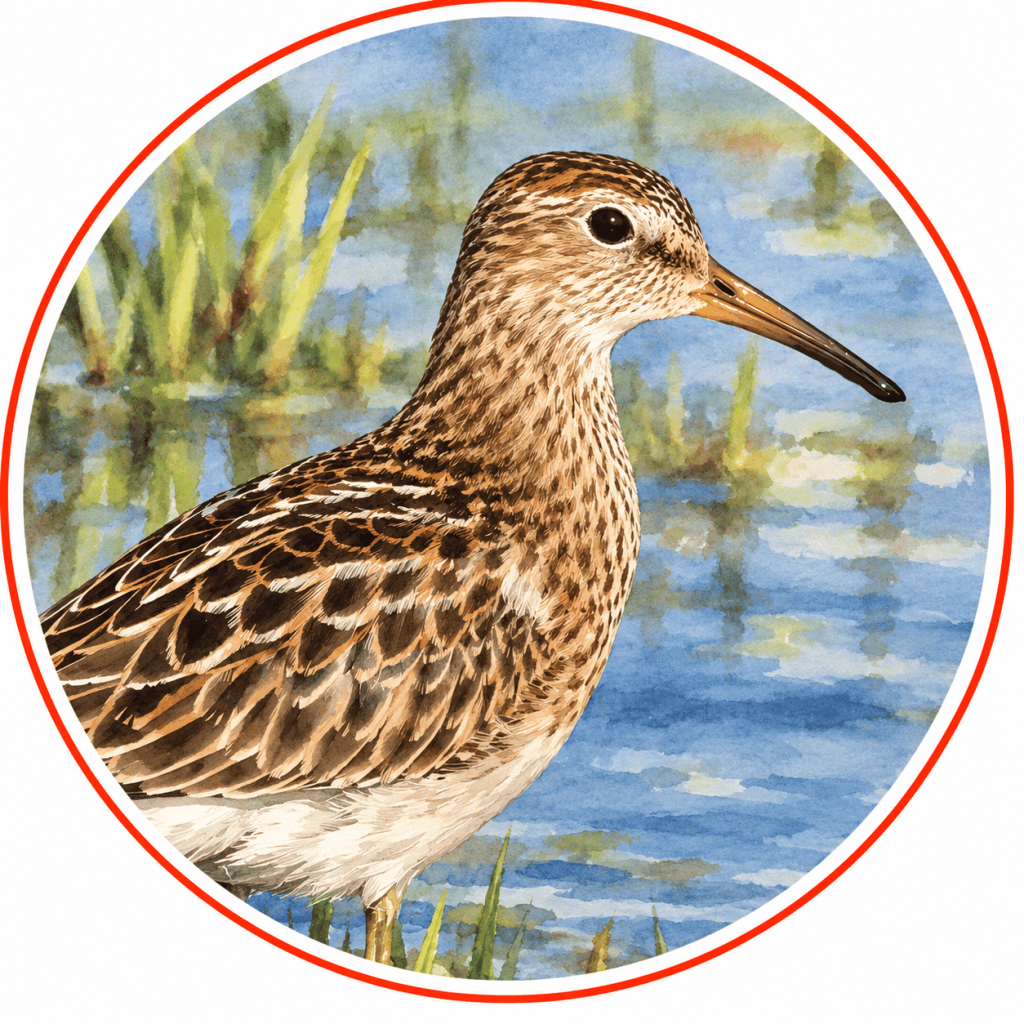
Scientific Name: Calidris melanotos
Family: Scolopacidae — Sandpipers and Allies
A long-distance migrant of North America’s wetlands, the Pectoral Sandpiper is recognized by its richly patterned brown plumage and sharply defined streaked breast. Breeding in Arctic tundra, it travels extraordinary distances to South American wintering grounds, often stopping in muddy wetlands.

Identification
A medium-sized sandpiper with yellowish to greenish legs, a moderately long bill with a slight droop near the tip, and a strongly streaked breast that ends abruptly against a clean white belly. That sharp lower border to the breast streaking is one of the best field marks. Juveniles are often crisply patterned above with warm rufous-edged scapulars and a neat pale supercilium.
Similar Species
Sharp-tailed Sandpiper is the species most likely to be confused with Pectoral Sandpiper, particularly in juvenile plumage. Both can show yellowish legs, strongly patterned brown upperparts, and streaking across the breast. Sharp-tailed Sandpiper typically shows a stronger rufous cap and more prominent pale supercilium, while Pectoral Sandpiper usually shows its characteristic densely streaked breast ending abruptly against a clean white belly. Least and Baird’s Sandpipers may occasionally enter the identification discussion, but both are smaller and differently proportioned and are generally less likely to cause confusion.
Natural History
Pectoral Sandpipers forage by walking steadily across mud and shallow water, picking prey from the surface and probing into soft substrate for insects, larvae, worms, and small crustaceans. Males on the Arctic breeding grounds perform remarkable displays, inflating an enlarged throat air sac and producing low, resonant booming sounds. The species is highly migratory, with many birds traveling from Arctic breeding grounds to southern South America
Habitat & Distribution
Breeds across Arctic tundra from northern North America into Siberia, favoring moist tundra, sedge meadows, and wet areas near ponds. During migration it is often found at freshwater mudflats, flooded fields, marsh edges, sewage ponds, and shallow wetlands, especially through the interior of North America. Most of the population winters in southern South America.
Conservation
IUCN Red List: Least Concern (LC) • Population trend: Decreasing
The species remains globally categorized as Least Concern, but migration monitoring and regional data have indicated declines in parts of its range, including Canada. Because it depends on widely separated Arctic breeding areas and wetland stopovers extending through the Americas, wetland loss, altered hydrology, contaminants, and rapid climate change in Arctic habitats are important conservation considerations.
My Encounters
[Place / Region]
[Describe a firsthand encounter with this species in this place. Focus on what you observed, photographed, noticed, or learned rather than simply recording that the species was present. Add additional geographic H3 sections only when meaningful encounters from other places warrant them.]
Through My Lens
[REPLACE EXAMPLE IMAGES AND CAPTIONS. Select photographs that add something beyond identification—behavior, habitat, season, light, movement, or another aspect of the encounter. Use the image orientation and layout that best serve the photographs rather than forcing images into a standard format. For landscape-oriented photographs, begin with one row of two images; add additional photographs only when they genuinely contribute.]

Ceres WTP, California — July 30, 2025
1/250 sec · f/10 · ISO 160

Ceres WTP, California — July 30, 2025
1/2500 sec · f/10 · ISO 6400
Explore More
[Related Place]
[Invite the reader to explore a place meaningfully connected with this species or encounter. Delete this pathway if there is no useful place connection.]
[Related Natural World – i.e., Shorebirds]
[Invite the reader to continue exploring a meaningful related group, habitat, organism, or natural-history topic. Choose the connection that best encourages further discovery rather than simply adding a related link.]
From Reflections of the Natural World
[When this species has a meaningful presence in a Reflections story, invite the reader to continue into that story. Include only stories in which the species contributes meaningfully to the encounter—not those where it merely appears on a list. Delete this pathway if no meaningful story connection exists.]

