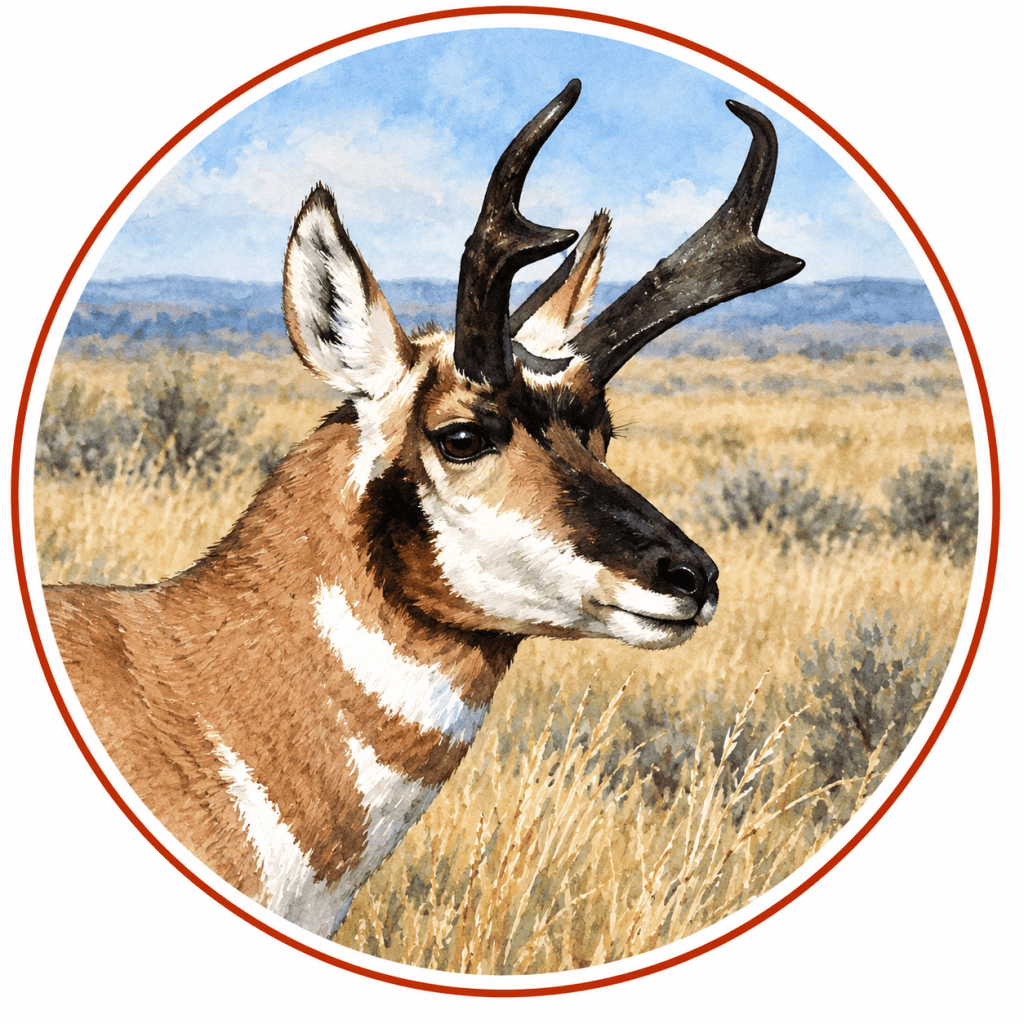
Scientific Name: Antilocapra americana
Family: Antilocapridae — Pronghorns
The fastest land mammal in North America, the Pronghorn is uniquely adapted to the continent’s open grasslands and sagebrush plains. Neither a true antelope nor a deer, this remarkable species possesses distinctive branched horns and exceptional eyesight, allowing it to detect predators across vast distances.

Identification
The Pronghorn is one of North America’s most extraordinary large mammals, combining exceptional speed, keen eyesight, and specialized adaptations for life in open landscapes. Often called the American antelope, it is neither a true antelope nor a deer, but the sole surviving representative of the family Antilocapridae.
Its tan-brown coat contrasts with white underparts, prominent white rump patches, and distinctive black-and-white facial markings. Both sexes may possess horns, although those of females are generally much smaller or absent. Unlike the permanent horns of cattle and antelope, Pronghorns periodically shed the outer keratin sheaths covering their bony horn cores.
Capable of sustained running speeds unmatched by other North American land mammals, the Pronghorn is particularly well adapted to the expansive grasslands and sagebrush plains it inhabits.
Similar Species
Mule Deer (Odocoileus hemionus): Both species inhabit western North American open country, but Mule Deer have large ears, a different facial pattern, and antlers rather than permanent horn cores. Pronghorns possess more sharply contrasting white and tan coloration, prominent white rump patches, and a distinctive running gait.
White-tailed Deer (Odocoileus virginianus): White-tailed Deer have a more uniformly brown coat, lack the Pronghorn’s bold facial markings, and possess branching antlers rather than pronged horns. When alarmed, they characteristically raise their white tails, whereas Pronghorns display their conspicuous white rump patches.
Natural History
Pronghorns are exceptionally fast runners, capable of reaching approximately 55 miles per hour in short bursts and maintaining impressive speeds over longer distances. Their large eyes provide a broad field of vision, allowing them to detect potential predators across open terrain.
Their diet consists primarily of forbs, shrubs, grasses, and sagebrush, varying with habitat and season. Herd structure changes throughout the year, with large winter groups often dispersing into smaller breeding-season units.
In many northern populations, seasonal movements connect distant summer and winter ranges. Unlike deer, Pronghorns generally prefer passing beneath fences rather than jumping over them, making fencing a significant obstacle to migration.
Females commonly give birth to twins, and newborn fawns rely on concealment during their earliest days.
Habitat & Distribution
Pronghorns inhabit western North America’s grasslands, sagebrush plains, shrub-steppe, and open desert landscapes. Their range extends from the Canadian Prairies through the western United States into northern Mexico.
They favor broad landscapes with relatively low vegetation, where unobstructed visibility helps them detect approaching danger. Access to seasonal forage and movement corridors is essential, particularly in regions with severe winters.
In Saskatchewan, Pronghorns occur primarily in the southern prairie regions, where native grasslands and agricultural landscapes provide suitable habitat near the northern limits of their continental range.
Conservation
IUCN Red List: Least Concern (LC)
Pronghorn populations declined catastrophically during the nineteenth and early twentieth centuries because of intensive hunting, habitat conversion, and unrestricted exploitation. Subsequent conservation programs, hunting regulations, and habitat protection enabled substantial recovery.
Despite this success, some populations remain vulnerable to habitat fragmentation, fencing, highway construction, drought, and restrictions on seasonal migration.
Certain geographically isolated populations, particularly in the southwestern United States and northern Mexico, require specialized conservation measures.
Protecting large, connected landscapes remains essential to preserving the Pronghorn’s remarkable migratory behavior and ecological role.
My Encounters
[Place / Region]
[Describe a firsthand encounter with this species in this place. Focus on what you observed, photographed, noticed, or learned rather than simply recording that the species was present. Add additional geographic H3 sections only when meaningful encounters from other places warrant them.]
Through My Lens
[REPLACE EXAMPLE IMAGES AND CAPTIONS. Select photographs that add something beyond identification—behavior, habitat, season, light, movement, or another aspect of the encounter. Use the image orientation and layout that best serve the photographs rather than forcing images into a standard format. For landscape-oriented photographs, begin with one row of two images; add additional photographs only when they genuinely contribute.]

Ceres WTP, California — July 30, 2025
1/250 sec · f/10 · ISO 160

Ceres WTP, California — July 30, 2025
1/2500 sec · f/10 · ISO 6400
Explore More
[Related Place]
[Invite the reader to explore a place meaningfully connected with this species or encounter. Delete this pathway if there is no useful place connection.]
[Related Natural World – i.e., Shorebirds]
[Invite the reader to continue exploring a meaningful related group, habitat, organism, or natural-history topic. Choose the connection that best encourages further discovery rather than simply adding a related link.]
From Reflections of the Natural World
[When this species has a meaningful presence in a Reflections story, invite the reader to continue into that story. Include only stories in which the species contributes meaningfully to the encounter—not those where it merely appears on a list. Delete this pathway if no meaningful story connection exists.]

