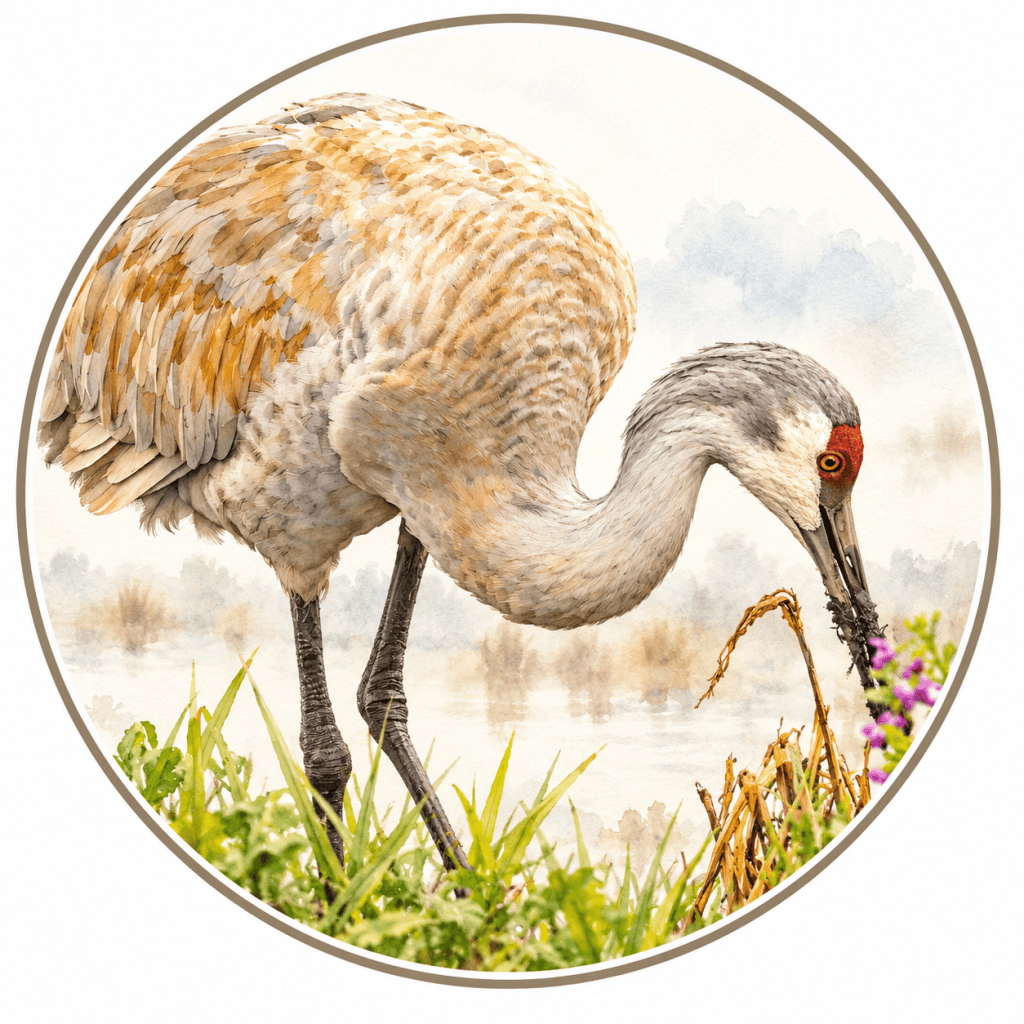
Scientific Name: Antigone canadensis
Family: Gruidae – Cranes
The Sandhill Crane is a tall, elegant wetland bird recognized by its long neck, gray plumage, and distinctive red crown. Its resonant, bugling calls carry across marshes and grasslands, while its elaborate courtship dances are among the most memorable displays in the bird world.

Identification
The Sandhill Crane is a tall, elegant wetland bird recognized by its long neck, long legs, broad wings, and distinctive rolling, bugling calls. Adults are predominantly gray, often with rusty-brown staining on their feathers, and possess a conspicuous patch of bare red skin on the crown.
In flight, cranes extend both their necks and legs, creating a graceful silhouette against the sky. Their powerful wingbeats and frequent soaring distinguish them from many other large wetland birds.
Sandhill Cranes are especially memorable during migration, when immense flocks gather at traditional staging areas and fill the landscape with their resonant calls.
Similar Species
Whooping Crane (Grus americana): Considerably rarer and somewhat larger, the adult Whooping Crane is predominantly white with black wingtips visible in flight. Sandhill Cranes are primarily gray, although immature birds may show rusty coloration. Both species possess red facial skin, but their overall plumage and size provide strong identification clues.
Great Blue Heron (Ardea herodias): Similar in height and grayish coloration, but the Great Blue Heron has a longer, dagger-like bill and typically flies with its neck folded into an S-shape. Sandhill Cranes fly with their necks fully extended and are more likely to travel in large, vocal flocks.
Natural History
Sandhill Cranes are among North America’s most ancient and recognizable bird lineages. They are celebrated for their elaborate courtship displays, which include bowing, jumping, wing spreading, and tossing vegetation into the air.
Pairs often maintain long-term bonds and cooperate in raising their young. Nests are generally constructed from wetland vegetation in shallow marshes, bogs, or wet meadows. Chicks are precocial, capable of walking and following their parents shortly after hatching.
Their diet is varied and includes seeds, grains, roots, insects, small vertebrates, and other available food resources.
During migration, cranes gather at traditional staging areas where they feed, rest, and prepare for long-distance flights. Their far-carrying calls result partly from an elongated windpipe that coils within the breastbone, amplifying their characteristic bugling voices.
Habitat & Distribution
Sandhill Cranes occupy a broad range across North America, breeding in Alaska, Canada, portions of the northern United States, and northeastern Siberia. Migratory populations winter primarily in the southern United States and northern Mexico, while several southern populations remain resident year-round.
They depend on wetlands for nesting and nighttime roosting, while frequently feeding in adjacent grasslands, agricultural fields, and open meadows.
Saskatchewan provides extensive breeding habitat and important migratory staging areas, particularly across its prairie pothole and parkland landscapes.
In California’s Central Valley, Sandhill Cranes are prominent winter visitors, gathering in agricultural fields and managed wetlands, where their calls and evening flights are characteristic features of the winter landscape.
Conservation
IUCN Red List: Least Concern (LC)
Sandhill Cranes have recovered substantially from historical declines caused by hunting and wetland destruction. Many migratory populations are stable or increasing, reflecting the benefits of legal protections, habitat management, and conservation programs.
However, not all populations share this success. The isolated Mississippi and Cuban populations remain of particular conservation concern.
Continued threats include wetland loss, altered water availability, collisions with power lines, and disturbance at traditional roosting and staging areas.
Maintaining healthy wetlands and surrounding agricultural or grassland feeding habitats is especially important along major migration corridors, including those connecting Saskatchewan and California.
My Encounters
[Place / Region]
[Describe a firsthand encounter with this species in this place. Focus on what you observed, photographed, noticed, or learned rather than simply recording that the species was present. Add additional geographic H3 sections only when meaningful encounters from other places warrant them.]
Through My Lens
[REPLACE EXAMPLE IMAGES AND CAPTIONS. Select photographs that add something beyond identification—behavior, habitat, season, light, movement, or another aspect of the encounter. Use the image orientation and layout that best serve the photographs rather than forcing images into a standard format. For landscape-oriented photographs, begin with one row of two images; add additional photographs only when they genuinely contribute.]

Ceres WTP, California — July 30, 2025
1/250 sec · f/10 · ISO 160

Ceres WTP, California — July 30, 2025
1/2500 sec · f/10 · ISO 6400
Explore More
[Related Place]
[Invite the reader to explore a place meaningfully connected with this species or encounter. Delete this pathway if there is no useful place connection.]
[Related Natural World – i.e., Shorebirds]
[Invite the reader to continue exploring a meaningful related group, habitat, organism, or natural-history topic. Choose the connection that best encourages further discovery rather than simply adding a related link.]
From Reflections of the Natural World
[When this species has a meaningful presence in a Reflections story, invite the reader to continue into that story. Include only stories in which the species contributes meaningfully to the encounter—not those where it merely appears on a list. Delete this pathway if no meaningful story connection exists.]

