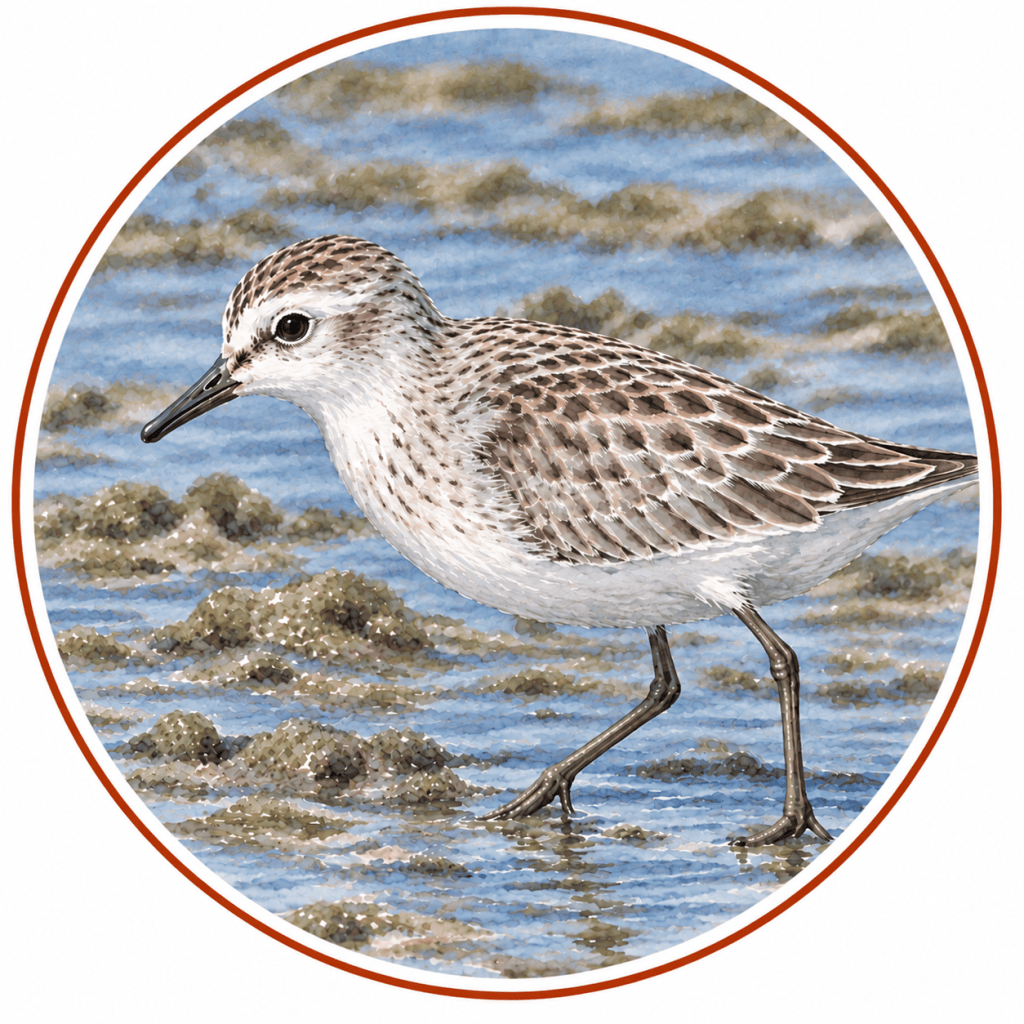
Scientific Name: Calidris pusilla
Family: Scolopacidae — Sandpipers and Allies
A small, long-distance migrant of North America’s wetlands, the Semipalmated Sandpiper is distinguished by its short, slightly bulbous-tipped bill, dark legs, and subtle gray-brown plumage. Breeding in Arctic tundra, it gathers in enormous flocks along coastal mudflats during its remarkable migrations.

Identification
A very small, compact sandpiper with black legs, a short-to-moderate straight dark bill, and gray-brown upperparts. Breeding birds show modest streaking on the breast and warmer patterning above; juveniles are neatly scaled. The species is named for the small amount of webbing between the toes, a feature usually difficult to see in the field. Bill length varies geographically, so identification should rely on a combination of structure, plumage, and behavior.
Similar Species
Western Sandpiper is the primary confusion species. Western generally has a longer, finer bill that often droops at the tip, more rufous in the scapulars in breeding plumage, and a slightly more attenuated shape; Semipalmated usually looks more compact and blunt-billed. Least Sandpiper is smaller with yellowish legs. Photographs that clearly show leg color, bill shape, scapular pattern, and body proportions are most useful.


Natural History
Semipalmated Sandpipers feed rapidly on exposed mud and in very shallow water, taking tiny crustaceans, insects, worms, mollusks, and other invertebrates. During migration they can form enormous flocks at rich staging areas, where individuals must accumulate fat quickly for long flights. They breed on Arctic tundra and migrate primarily to coastal and wetland wintering areas in northern South America.
Habitat & Distribution
Breeds across the North American Arctic from Alaska east through northern Canada. During migration it uses mudflats, tidal flats, shallow freshwater wetlands, lake margins, and flooded fields, with several major staging areas supporting very large concentrations. Most winter along the coasts of northern and northeastern South America, with smaller numbers elsewhere in the Americas.
Conservation
IUCN Red List: Near Threatened (NT) • Population trend: Decreasing
Semipalmated Sandpiper is Near Threatened globally. Long-term declines, especially in parts of the eastern population, have focused attention on the vulnerability of major migration staging and wintering sites. Habitat loss and degradation, disturbance, hunting in parts of the nonbreeding range, and changes in food resources and Arctic conditions can affect survival across its long migration system.
My Encounters
[Place / Region]
[Describe a firsthand encounter with this species in this place. Focus on what you observed, photographed, noticed, or learned rather than simply recording that the species was present. Add additional geographic H3 sections only when meaningful encounters from other places warrant them.]
Through My Lens
[REPLACE EXAMPLE IMAGES AND CAPTIONS. Select photographs that add something beyond identification—behavior, habitat, season, light, movement, or another aspect of the encounter. Use the image orientation and layout that best serve the photographs rather than forcing images into a standard format. For landscape-oriented photographs, begin with one row of two images; add additional photographs only when they genuinely contribute.]

Ceres WTP, California — July 30, 2025
1/250 sec · f/10 · ISO 160

Ceres WTP, California — July 30, 2025
1/2500 sec · f/10 · ISO 6400
Explore More
[Related Place]
[Invite the reader to explore a place meaningfully connected with this species or encounter. Delete this pathway if there is no useful place connection.]
[Related Natural World – i.e., Shorebirds]
[Invite the reader to continue exploring a meaningful related group, habitat, organism, or natural-history topic. Choose the connection that best encourages further discovery rather than simply adding a related link.]
From Reflections of the Natural World
[When this species has a meaningful presence in a Reflections story, invite the reader to continue into that story. Include only stories in which the species contributes meaningfully to the encounter—not those where it merely appears on a list. Delete this pathway if no meaningful story connection exists.]

