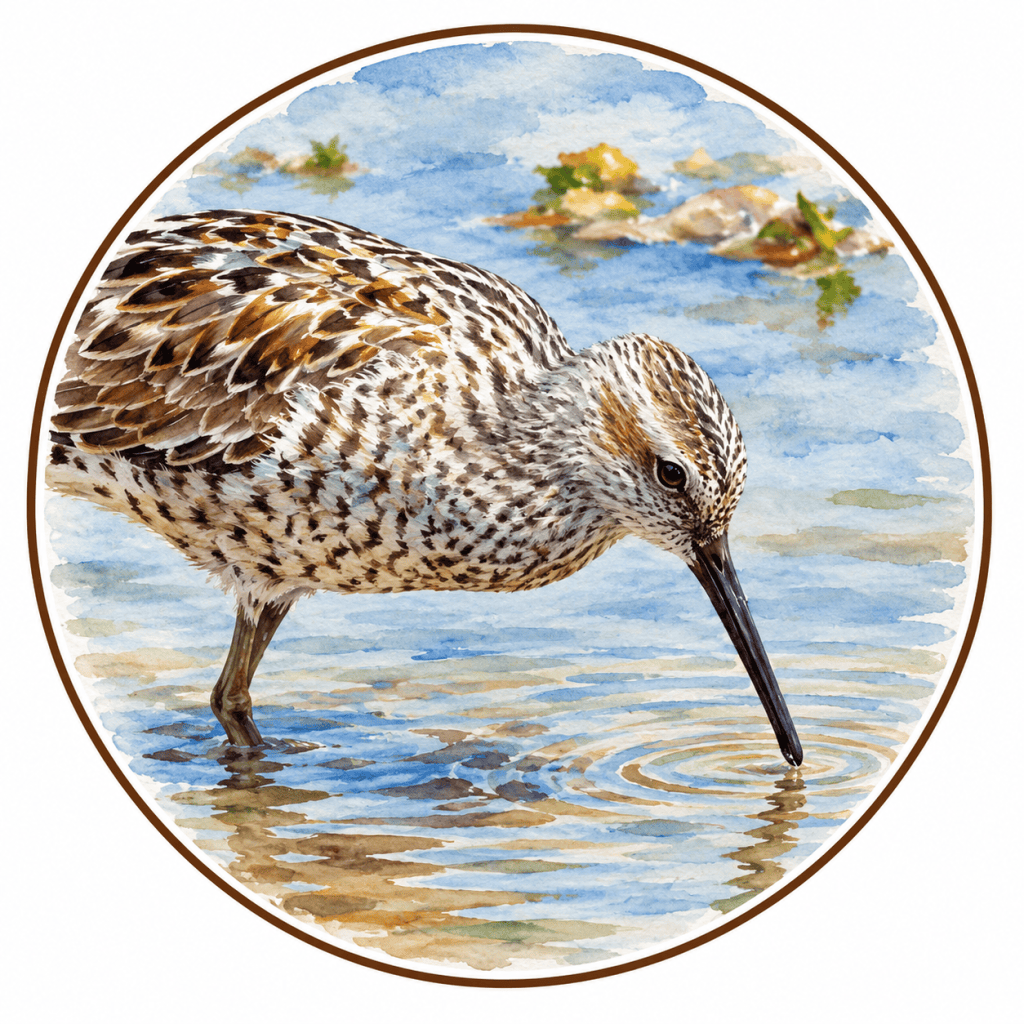
Scientific Name: Calidris himantopus
Family: Scolopacidae — Sandpipers and Allies
A slender shorebird of North America’s wetlands, the Stilt Sandpiper is distinguished by its long yellowish legs, slightly downcurved bill, and intricate breeding plumage. Often feeding in shallow water, it probes methodically for aquatic invertebrates during migration.

Identification
A medium-sized, long-legged sandpiper with a relatively long, slightly downcurved bill and a distinctly attenuated appearance. Breeding adults show heavy barring below, chestnut on the face and ear coverts, and patterned upperparts. Nonbreeding birds are much grayer but retain the long greenish-yellow legs and gently drooping bill. Feeding birds often wade belly-deep and probe rapidly.
Similar Species
Long-billed Dowitcher is a frequent source of confusion because both can feed deeply in water and show long bills, but Stilt Sandpiper is slimmer, longer-legged, and has a more delicate, slightly downcurved bill. In breeding plumage its barred underparts can also suggest Curlew Sandpiper, but Stilt Sandpiper has longer, yellow-green legs and different body proportions. Photographs showing the entire bill, legs, and side profile are especially useful.


Natural History
Stilt Sandpipers feed by probing rapidly in shallow water and mud, often using a repeated up-and-down motion reminiscent of dowitchers. They take aquatic insects, larvae, small crustaceans, mollusks, and other invertebrates. They breed on Arctic and subarctic tundra, nesting on the ground near sedge wetlands and shallow pools, and undertake long migrations to wintering areas mainly in South America.
Habitat & Distribution
Breeds primarily in Arctic and subarctic North America, especially northern Alaska and Canada. During migration it concentrates at shallow freshwater wetlands, flooded fields, sewage ponds, marshes, and mudflats, particularly through the continent’s interior. Most winter in central and southern South America, where shallow wetlands and seasonally flooded habitats remain important.
IUCN Red List: Near Threatened (NT) • Population trend: Decreasing
Stilt Sandpiper was moved from Least Concern to Near Threatened in the 2024-2 IUCN update. Recent evidence indicates a substantial population decline, with estimates on the order of roughly 20–29% over three generations. The causes are not fully resolved, making protection of breeding, migration, and wintering wetlands especially important while monitoring and research continue.
My Encounters
Saskatchewan
I encountered Lesser Yellowlegs along the shallow margins of the Crawford Lake area in southern Saskatchewan, where shorebirds were feeding along the exposed wetland edge during my late-summer visit. It was one of several shorebird species that drew my attention that afternoon before the distant calls of Sandhill Cranes changed the character of the day—and ultimately became the story I remembered most.
Through My Lens
A selection of photographs from my encounters with Lesser Yellowlegs in different places and seasons.

Ceres WTP, California — July 30, 2025
1/250 sec · f/10 · ISO 160

Ceres WTP, California — July 30, 2025
1/2500 sec · f/10 · ISO 6400
Explore More
Crawford Lake Area
Explore the southern Saskatchewan wetland where I encountered Lesser Yellowlegs and other migrating shorebirds.
Shorebirds
Explore other shorebirds I have encountered and photographed across wetlands, shorelines, mudflats, grasslands, and other habitats.
From Reflections of the Natural World
When the Cranes Changed the Season — A late-summer afternoon at Crawford Lake when shorebirds filled the wetland margins before the distant calls of Sandhill Cranes changed the character of the day.

