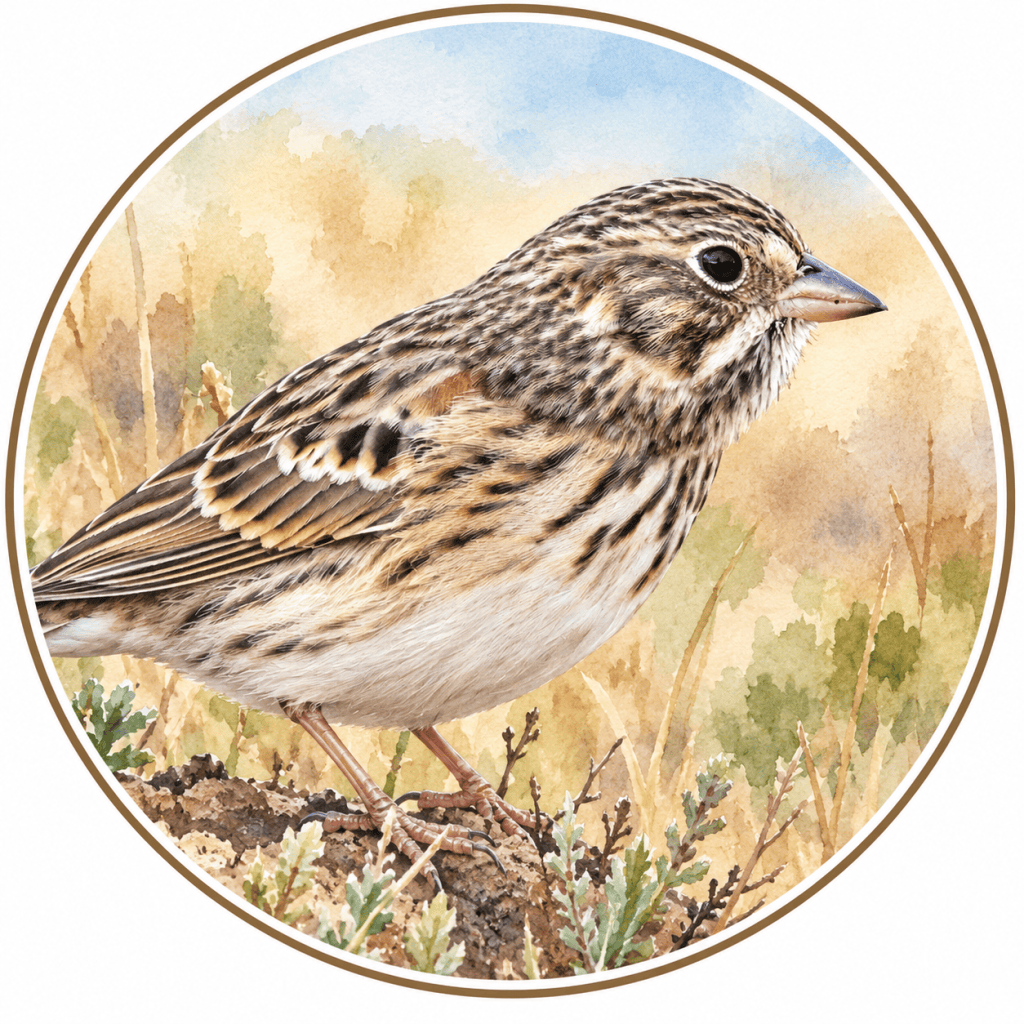
Scientific Name: Pooecetes gramineus
Family: Passerellidae – New World Sparrows
The Vesper Sparrow is a subtly patterned grassland bird distinguished by its bold white eye-ring, streaked plumage, and white outer tail feathers. Found in open fields and prairies, it is celebrated for its sweet, musical songs, often delivered at dusk.

Identification
A fairly large, pale, streaked sparrow of open country with a distinct white eye-ring, brown-streaked breast and flanks, and white outer tail feathers that flash in flight. A small chestnut patch at the shoulder can be visible at close range but is often concealed. The face is relatively plain compared with many other sparrows.
Similar Species
Savannah Sparrow is the species most likely to be confused with Vesper Sparrow. Both occur in open grasslands and agricultural landscapes and can appear similarly brown and streaked at first glance. Vesper Sparrow typically shows a bold whitish eye-ring, a relatively plain facial pattern, and white outer tail feathers that are especially conspicuous in flight. Savannah Sparrow usually shows a more strongly patterned face, often with yellow in front of or above the eye, and more extensive, crisper streaking across the breast. Vesper Sparrow may also show a chestnut patch on the shoulder, although this feature can be difficult to see in the field.


Baird’s Sparrow can present a more subtle identification challenge where the two species share northern grasslands. Baird’s Sparrow has a flatter-headed appearance, a more intricately patterned face and crown, and fine streaking concentrated across the upper breast. Unlike Vesper Sparrow, it lacks the conspicuous white outer tail feathers. Behavior can also help: Vesper Sparrows frequently perch in exposed locations such as fence posts, wires, shrubs, or the tops of vegetation, while Baird’s Sparrows often remain low and concealed within the grass.
Natural History
A ground-foraging sparrow that eats seeds for much of the year and adds insects during the breeding season. Males often sing from fence posts, shrubs, wires, or other elevated perches, especially in the long light of spring and early summer evenings. Nests are placed on the ground, usually concealed beside vegetation in relatively open grassland.
Habitat & Distribution
Breeds across open country in much of western and northern North America, using native and grazed grasslands, sagebrush openings, prairie edges, agricultural fields, and other sparsely vegetated habitats. It often favors areas with some bare ground and scattered elevated song perches. Most populations migrate south to winter in the southern United States and Mexico.
Conservation
IUCN Red List: Least Concern (LC) • Population trend: Decreasing
The species remains Least Concern globally, but populations have declined across substantial portions of its range. Loss and fragmentation of grasslands, agricultural intensification, changes in grazing and mowing, succession of open land to woody vegetation, and pesticide-related reductions in food can all reduce habitat quality. Regional populations can be much more vulnerable than the global category suggests.
My Encounters
[Place / Region]
[Describe a firsthand encounter with this species in this place. Focus on what you observed, photographed, noticed, or learned rather than simply recording that the species was present. Add additional geographic H3 sections only when meaningful encounters from other places warrant them.]
Through My Lens
[REPLACE EXAMPLE IMAGES AND CAPTIONS. Select photographs that add something beyond identification—behavior, habitat, season, light, movement, or another aspect of the encounter. Use the image orientation and layout that best serve the photographs rather than forcing images into a standard format. For landscape-oriented photographs, begin with one row of two images; add additional photographs only when they genuinely contribute.]

Ceres WTP, California — July 30, 2025
1/250 sec · f/10 · ISO 160

Ceres WTP, California — July 30, 2025
1/2500 sec · f/10 · ISO 6400
Explore More
[Related Place]
[Invite the reader to explore a place meaningfully connected with this species or encounter. Delete this pathway if there is no useful place connection.]
[Related Natural World – i.e., Shorebirds]
[Invite the reader to continue exploring a meaningful related group, habitat, organism, or natural-history topic. Choose the connection that best encourages further discovery rather than simply adding a related link.]
From Reflections of the Natural World
[When this species has a meaningful presence in a Reflections story, invite the reader to continue into that story. Include only stories in which the species contributes meaningfully to the encounter—not those where it merely appears on a list. Delete this pathway if no meaningful story connection exists.]

