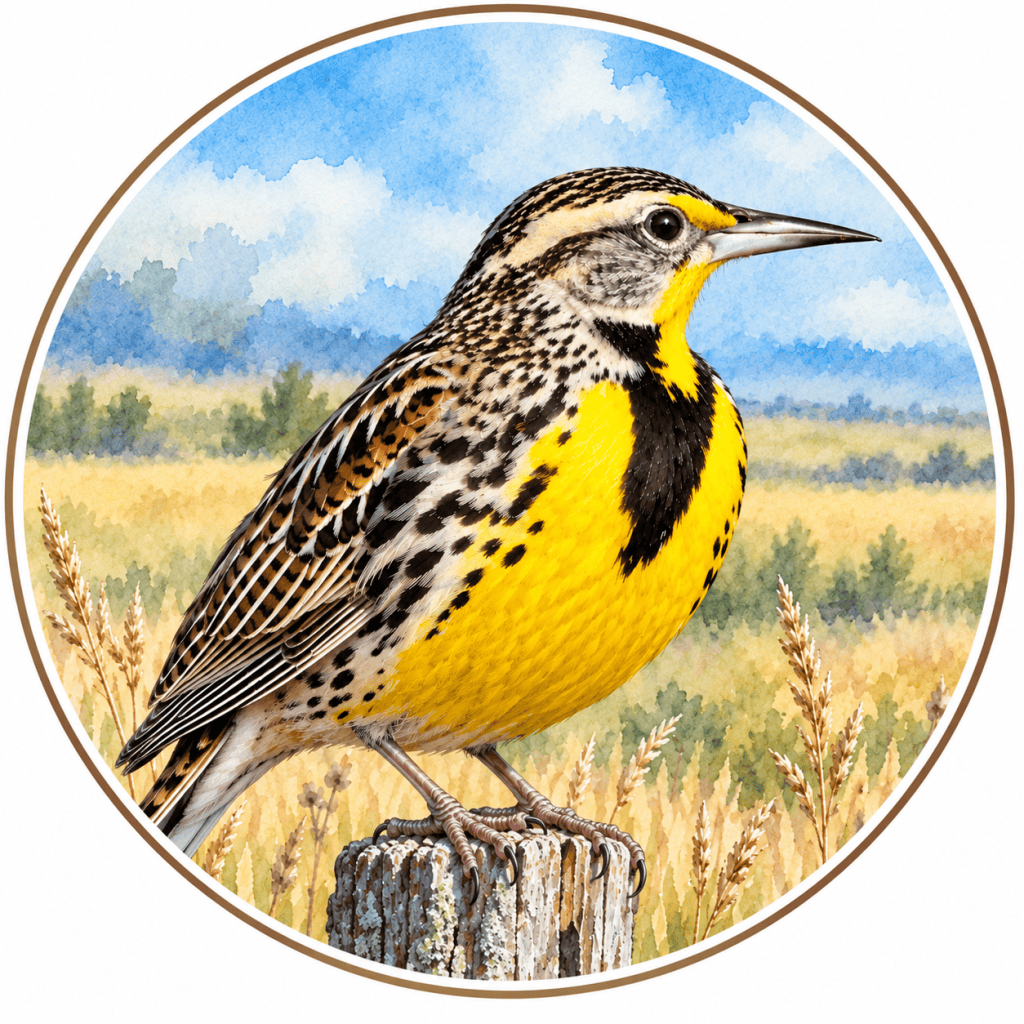
Scientific Name: Sturnella neglecta
Family: Icteridae — Blackbirds and Orioles
A familiar voice of western North America’s open grasslands, the Western Meadowlark is celebrated for its rich, flute-like song. Its brilliant yellow breast, bold black V-shaped marking, and intricately patterned plumage make it equally memorable to see.

Identification
A chunky, short-tailed grassland bird with a long pointed bill, brown-and-buff streaked upperparts, bright yellow underparts, and a bold black V across the breast. The outer tail feathers are white and conspicuous in flight. The face shows a pale eyebrow and dark stripes. Voice is often the easiest way to distinguish it from Eastern Meadowlark where the two overlap
Similar Species
Eastern Meadowlark is extremely similar visually. Western Meadowlark generally has more yellow extending into the malar area, somewhat paler upperparts, and subtle differences in head pattern, but these features overlap. Song and call are usually more reliable: Western gives a rich, flutelike series of descending whistles, whereas Eastern typically sings a simpler, clearer whistled phrase. Photographs alone may not always permit confident identification in overlap zones.
Natural History
Western Meadowlarks forage mainly on the ground for insects, seeds, and other small food items. Males sing conspicuously from fence posts and other elevated perches, while nests are hidden on the ground in grasses and often covered by a woven grass roof or arch. The species is strongly tied to open landscapes and is one of the characteristic voices of western North American grasslands.
Habitat & Distribution
Breeds widely across western and central North America in native prairie, pasture, rangeland, agricultural fields, open sagebrush country, and other grass-dominated habitats. It generally avoids dense woody vegetation. Northern populations migrate southward, while many birds in milder parts of the range are resident or move only short distances.
Conservation
IUCN Red List: Least Concern (LC) • Population trend: Decreasing
Western Meadowlark remains Least Concern globally but has undergone substantial long-term declines in many regions. Canadian monitoring has documented a decline approaching half of the population since 1970, with habitat loss considered an important driver. Conversion and fragmentation of grasslands, intensive agriculture, mowing, pesticide use, and changes in grazing or vegetation structure can reduce breeding habitat and food resources.
My Encounters
[Place / Region]
[Describe a firsthand encounter with this species in this place. Focus on what you observed, photographed, noticed, or learned rather than simply recording that the species was present. Add additional geographic H3 sections only when meaningful encounters from other places warrant them.]
Through My Lens
[REPLACE EXAMPLE IMAGES AND CAPTIONS. Select photographs that add something beyond identification—behavior, habitat, season, light, movement, or another aspect of the encounter. Use the image orientation and layout that best serve the photographs rather than forcing images into a standard format. For landscape-oriented photographs, begin with one row of two images; add additional photographs only when they genuinely contribute.]

Ceres WTP, California — July 30, 2025
1/250 sec · f/10 · ISO 160

Ceres WTP, California — July 30, 2025
1/2500 sec · f/10 · ISO 6400
Explore More
[Related Place]
[Invite the reader to explore a place meaningfully connected with this species or encounter. Delete this pathway if there is no useful place connection.]
[Related Natural World – i.e., Shorebirds]
[Invite the reader to continue exploring a meaningful related group, habitat, organism, or natural-history topic. Choose the connection that best encourages further discovery rather than simply adding a related link.]
From Reflections of the Natural World
[When this species has a meaningful presence in a Reflections story, invite the reader to continue into that story. Include only stories in which the species contributes meaningfully to the encounter—not those where it merely appears on a list. Delete this pathway if no meaningful story connection exists.]

