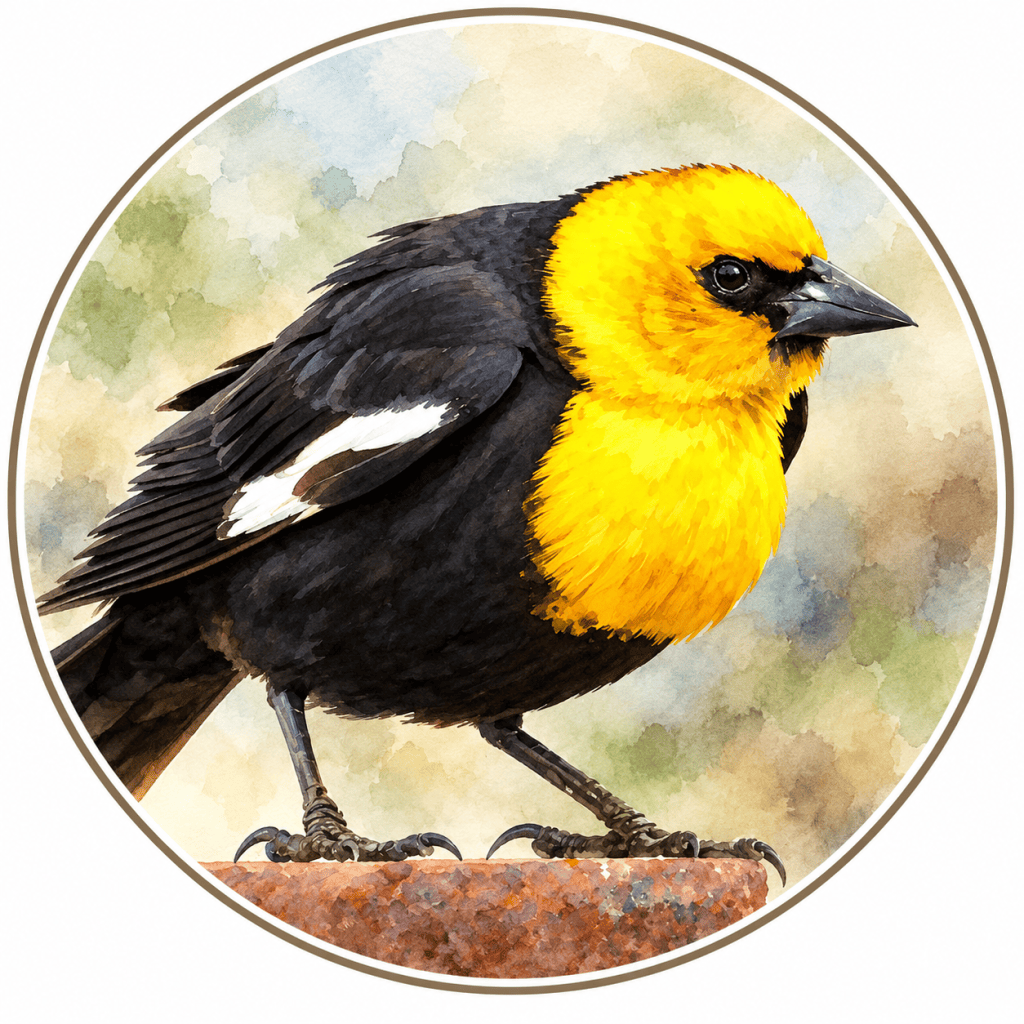
Scientific Name: Xanthocephalus xanthocephalus
Family: Icteridae – Blackbirds and Orioles
The Yellow-headed Blackbird is a striking marshland bird with a brilliant golden-yellow head, black body, and bold white wing patches. Breeding in western North American wetlands, males are known for their harsh, mechanical calls and conspicuous displays.

Identification
Adult males are unmistakable: a brilliant yellow head and upper breast contrast with an otherwise black body, and white wing patches are especially conspicuous in flight. Females are much browner, with a dull yellow throat and breast and less extensive yellow on the head. Both sexes are large, heavy-bodied blackbirds with stout, pointed bills.
Similar Species
Adult males are unlikely to be confused with any other North American bird. Females and immatures can resemble female Red-winged Blackbirds at a glance, but Yellow-headed Blackbirds are larger and bulkier, with a heavier bill, less strongly streaked underparts, and concentrated yellow on the throat and breast. Watching body size and bill structure is especially helpful in mixed blackbird flocks.
Natural History
A colonial marsh-nesting blackbird strongly associated with emergent vegetation such as cattails and bulrushes. Males are often polygynous and defend territories containing the nests of several females. They feed heavily on insects during the breeding season and shift toward seeds and grains at other times, often joining large mixed-species blackbird flocks after nesting.
Habitat & Distribution
Breeds mainly in freshwater marshes across western and central North America, especially where deep water surrounds dense stands of emergent vegetation. It is particularly characteristic of prairie-pothole and western marsh landscapes. After breeding, birds move through agricultural areas, wetlands, and grasslands, with most wintering in the southwestern United States and Mexico.
Conservation
IUCN Red List: Least Concern (LC) • Population trend: Stable / fluctuating regionally
Globally the species remains Least Concern, but its dependence on productive marshes makes it sensitive to wetland drainage, drought, water-level changes, and long-term reductions in marsh habitat. Canadian monitoring has shown large fluctuations and substantial regional variation, with abundance responding to climatic cycles that influence western wetland water levels. Local declines can therefore occur even when the global category remains secure.
My Encounters
[Place / Region]
[Describe a firsthand encounter with this species in this place. Focus on what you observed, photographed, noticed, or learned rather than simply recording that the species was present. Add additional geographic H3 sections only when meaningful encounters from other places warrant them.]
Through My Lens
[REPLACE EXAMPLE IMAGES AND CAPTIONS. Select photographs that add something beyond identification—behavior, habitat, season, light, movement, or another aspect of the encounter. Use the image orientation and layout that best serve the photographs rather than forcing images into a standard format. For landscape-oriented photographs, begin with one row of two images; add additional photographs only when they genuinely contribute.]

Ceres WTP, California — July 30, 2025
1/250 sec · f/10 · ISO 160

Ceres WTP, California — July 30, 2025
1/2500 sec · f/10 · ISO 6400
Explore More
[Related Place]
[Invite the reader to explore a place meaningfully connected with this species or encounter. Delete this pathway if there is no useful place connection.]
[Related Natural World – i.e., Shorebirds]
[Invite the reader to continue exploring a meaningful related group, habitat, organism, or natural-history topic. Choose the connection that best encourages further discovery rather than simply adding a related link.]
From Reflections of the Natural World
[When this species has a meaningful presence in a Reflections story, invite the reader to continue into that story. Include only stories in which the species contributes meaningfully to the encounter—not those where it merely appears on a list. Delete this pathway if no meaningful story connection exists.]

