← Back to Flycatchers and Kingbirds
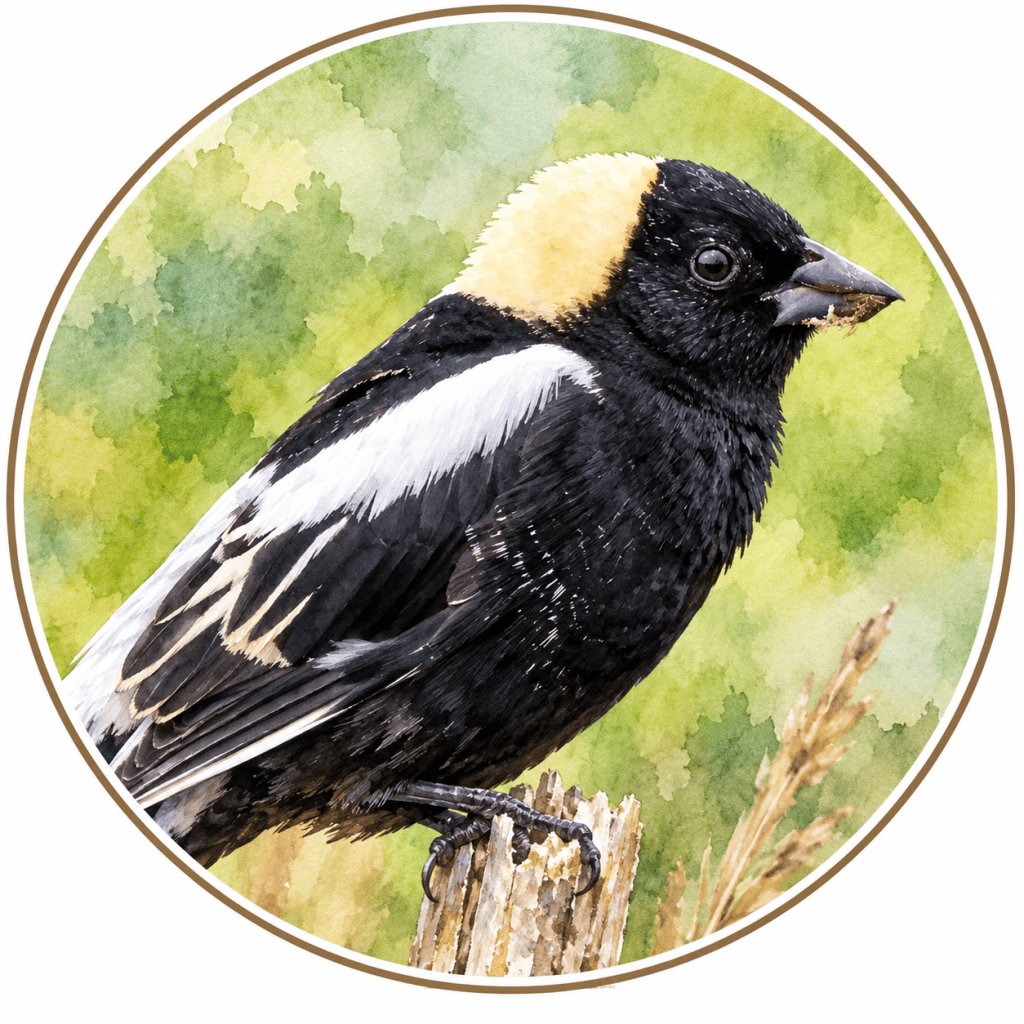
Scientific Name: Dolichonyx oryzivorus
Family: Icteridae – Blackbirds and Orioles
The Bobolink is a distinctive grassland songbird whose breeding males display black plumage, a creamy golden nape, and bold white markings. Famous for their bubbling, musical songs, Bobolinks undertake remarkable migrations between North American breeding grounds and South American wintering areas.
Dolichonyx oryzivorus
Family: Icteridae — Blackbirds and Orioles

Identification
Breeding males are extraordinary and nearly unmistakable: mostly black below and on the face, with a pale buff-to-cream nape, white scapulars and rump, creating a pattern that seems almost reversed from a typical dark-backed songbird. Females, immatures, and nonbreeding males are warm buffy-brown with dark streaking, a bold pale supercilium, and a pointed, finch-like bill.
Similar Species
Breeding male Bobolinks are essentially unmistakable in North America, with their black underparts, pale back and rump, and buffy nape. Females and nonbreeding birds present a greater identification challenge and can superficially resemble longspurs or large sparrows. Their warm buff coloration, strong head stripes, relatively pointed tail feathers, and overall blackbird-like structure are useful identification clues. In flight, their distinctive calls may provide an important clue before the bird is seen well.
Natural History
Bobolinks are grassland blackbirds famous for the male’s bubbling, mechanical-sounding song delivered in display flights. They nest on the ground in dense grasses and feed on insects and seeds. They are among the hemisphere’s most remarkable songbird migrants, traveling from North American breeding grounds to central South America and back each year, a round trip that can approach 20,000 km
Habitat & Distribution
Originally associated with native tallgrass and mixed-grass prairies and meadows, Bobolinks now also breed extensively in hayfields, pastures, and other agricultural grasslands. This adaptation creates a conflict because mowing can occur while nests still contain eggs or young. During migration they use grasslands, marshes, and agricultural landscapes; wintering birds concentrate in grasslands and rice-growing regions of South America.
Conservation
IUCN Red List: Near Threatened (NT) • Population trend: Decreasing
Bobolink was moved from Least Concern to Near Threatened in the 2025-2 IUCN update, reflecting a genuine deterioration in status. Long-term declines are strongly associated with grassland loss and agricultural intensification. Early and frequent hay cutting can destroy nests and young, while habitat loss, pesticides, and persecution or lethal control in parts of the nonbreeding range add pressure across the annual cycle. Canadian assessments have likewise documented substantial long-term declines.
My Encounters
[Place / Region]
[Describe a firsthand encounter with this species in this place. Focus on what you observed, photographed, noticed, or learned rather than simply recording that the species was present. Add additional geographic H3 sections only when meaningful encounters from other places warrant them.]
Through My Lens
[REPLACE EXAMPLE IMAGES AND CAPTIONS. Select photographs that add something beyond identification—behavior, habitat, season, light, movement, or another aspect of the encounter. Use the image orientation and layout that best serve the photographs rather than forcing images into a standard format. For landscape-oriented photographs, begin with one row of two images; add additional photographs only when they genuinely contribute.]

Ceres WTP, California — July 30, 2025
1/250 sec · f/10 · ISO 160

Ceres WTP, California — July 30, 2025
1/2500 sec · f/10 · ISO 6400
Explore More
[Related Place]
[Invite the reader to explore a place meaningfully connected with this species or encounter. Delete this pathway if there is no useful place connection.]
[Related Natural World – i.e., Shorebirds]
[Invite the reader to continue exploring a meaningful related group, habitat, organism, or natural-history topic. Choose the connection that best encourages further discovery rather than simply adding a related link.]
From Reflections of the Natural World
[When this species has a meaningful presence in a Reflections story, invite the reader to continue into that story. Include only stories in which the species contributes meaningfully to the encounter—not those where it merely appears on a list. Delete this pathway if no meaningful story connection exists.]

