← Back to Flycatchers and Kingbirds
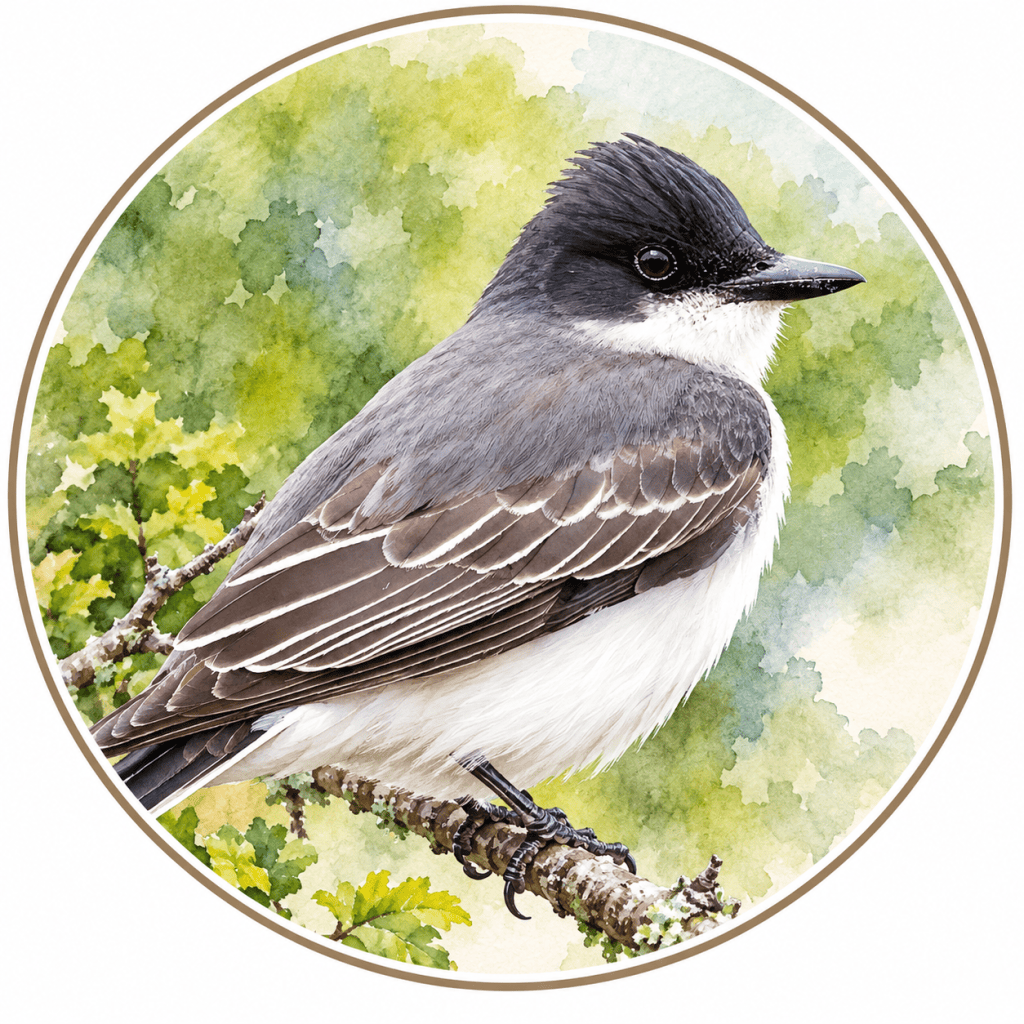
Scientific Name: Tyrannus tyrannus
Family: Tyrannidae – Tyrant Flycatchers
The Eastern Kingbird is a bold, migratory flycatcher recognized by its dark head, gray-black upperparts, white underparts, and white-tipped tail. Often perched conspicuously in open habitats, it aggressively defends its territory and captures flying insects with remarkable aerial agility.

Identification
A sharply patterned flycatcher with dark slate-gray to blackish upperparts, clean white underparts, and a black tail ending in a conspicuous white terminal band. The crown conceals a small orange-red patch that is rarely visible. Its upright posture, broad shoulders, and habit of sallying from exposed perches are characteristic.
Similar Species (Optional if Necessary)
Eastern Phoebe is smaller and browner-gray, lacks the white tail tip, and repeatedly pumps its tail. Gray Kingbird is much paler above and occurs mainly in the southeastern coastal region and Caribbean. Western Kingbird has a gray head, yellow belly, and different tail pattern. A clear photograph of the tail tip and underparts usually resolves the identification quickly.
Natural History
Eastern Kingbirds are aerial insectivores, watching from exposed perches and flying out to capture insects in midair before returning to a perch. They are famously aggressive around the nest and may attack much larger birds. Unlike their largely insect-based breeding diet, they consume substantial fruit on the South American wintering grounds. They form a long-distance migration connection between North and South America.
Habitat & Distribution
Breeds across much of North America in open and semi-open landscapes with scattered trees, shrubs, fences, or other perches, including grasslands, farms, wetland edges, riparian openings, and roadsides. Nests are usually placed in trees or shrubs. After migration through Central America, most winter in tropical South America, often in forest edges and open habitats where fruit is abundant.
Conservation
IUCN Red List: Least Concern (LC) • Population trend: Decreasing
Despite its broad range and Least Concern status, Eastern Kingbird populations have shown a long-term continental decline. Causes are not fully understood and may involve changes in agricultural landscapes, insect availability, pesticide exposure, habitat conditions on migration and wintering grounds, and other factors acting across the annual cycle. Its status is a good example of why an LC category should not end the conservation discussion.
My Encounters
[Place / Region]
[Describe a firsthand encounter with this species in this place. Focus on what you observed, photographed, noticed, or learned rather than simply recording that the species was present. Add additional geographic H3 sections only when meaningful encounters from other places warrant them.]
Through My Lens
[REPLACE EXAMPLE IMAGES AND CAPTIONS. Select photographs that add something beyond identification—behavior, habitat, season, light, movement, or another aspect of the encounter. Use the image orientation and layout that best serve the photographs rather than forcing images into a standard format. For landscape-oriented photographs, begin with one row of two images; add additional photographs only when they genuinely contribute.]

Ceres WTP, California — July 30, 2025
1/250 sec · f/10 · ISO 160

Ceres WTP, California — July 30, 2025
1/2500 sec · f/10 · ISO 6400
Explore More
[Related Place]
[Invite the reader to explore a place meaningfully connected with this species or encounter. Delete this pathway if there is no useful place connection.]
[Related Natural World – i.e., Shorebirds]
[Invite the reader to continue exploring a meaningful related group, habitat, organism, or natural-history topic. Choose the connection that best encourages further discovery rather than simply adding a related link.]
From Reflections of the Natural World
[When this species has a meaningful presence in a Reflections story, invite the reader to continue into that story. Include only stories in which the species contributes meaningfully to the encounter—not those where it merely appears on a list. Delete this pathway if no meaningful story connection exists.]

